
Intelligent autonomy is the ability of a system, whether software, a robot, or a vehicle, to perceive its environment, reason through a decision, and act on it without a human approving each step. Traditional automation follows a fixed script: if this happens, do that. Intelligent autonomy follows a goal instead, and figures out the steps itself, adapting when the situation does not match what it expected.
For a business evaluating this, the distinction that matters is not the AI buzzword. It is whether the system can handle the exceptions your current automation cannot, without you rewriting the rules every time something changes.
A survey found that 23 percent of organizations are already actively scaling an agentic AI system in at least one business function, with another 39 percent experimenting. This piece covers what intelligent autonomy actually means, the levels it comes in, where it is being applied, and where DGlide's AI-driven workflow automation fits inside that picture.
TL;DR
Intelligent autonomy is defined by a goal-driven perceive, reason, act loop, not by how advanced the interface looks.
Autonomy comes in tiers, and most businesses need conditional autonomy with human escalation, not full autonomy everywhere.
Enterprise workflow automation is one of four core application areas, alongside robotics, autonomous vehicles, and defense systems.
Gartner itself predicts most agentic AI projects will be cancelled by 2027, mostly from governance gaps, not the technology failing.
DGlide applies conditional, explainable autonomy to IT, HR, CRM, and citizen service workflows specifically, not physical robotics.
What Is Intelligent Autonomy?
Intelligent autonomy refers to systems or machines that operate and make decisions independently to achieve a specific goal, without requiring constant human oversight. Powered by artificial intelligence, machine learning, and sensor or data fusion, these systems perceive their environment, reason through a situation, and take the appropriate action, then learn from the outcome.
This differs from traditional automation in one key way. Automation executes a predefined path reliably. Autonomy understands the goal well enough to choose its own path when the predefined one does not apply.
How It Works: The Perceive-Reason-Act Loop
Intelligent autonomy runs on a continuous loop that turns raw information into a decision and then into action, unlike traditional automation's single fixed script. Four stages repeat continuously, each feeding the next.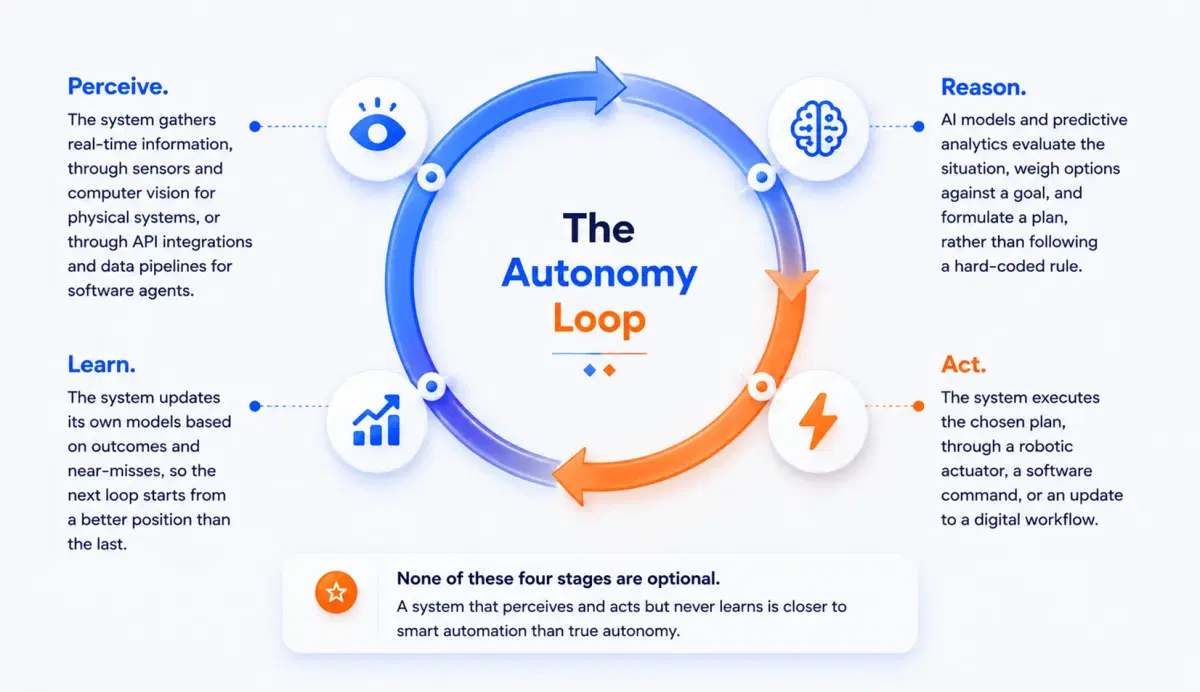
Perceive. The system gathers real-time information, through sensors and computer vision for physical systems, or through API integrations and data pipelines for software agents.
Reason. AI models and predictive analytics evaluate the situation, weigh options against a goal, and formulate a plan, rather than following a hard-coded rule.
Act. The system executes the chosen plan, through a robotic actuator, a software command, or an update to a digital workflow.
Learn. The system updates its own models based on outcomes and near-misses, so the next loop starts from a better position than the last.
None of these four stages are optional. A system that perceives and acts but never learns is closer to smart automation than true autonomy.
What Are the Levels of Autonomy?
Autonomy is not a single switch, it is a spectrum, and most frameworks describe four tiers based on how much a human still has to approve. Knowing which tier a vendor is actually offering matters more than the word "autonomous" on their homepage.
Assisted or rule-based. The system executes specific, hard-coded rules and needs a human for any deviation.
Collaborative. The system recommends or assists with a task, but a human must actively authorize the decision.
Conditional, or agentic. The system operates on its own within defined guardrails, but escalates unresolved conflicts or high-risk situations to a human.
Fully autonomous. The system makes and executes strategic, high-level decisions independently, with no human step in the loop.
Curious which tier your current automation actually operates at, versus what the vendor calls it? Ask us to map it out in a 15-minute call.
What Are the Core Applications of Intelligent Autonomy?
Intelligent autonomy is moving from research concept to deployed systems across four distinct areas, and enterprise software is only one of them. Knowing the other three matters because most "intelligent autonomy" content written for a general audience is actually about the other three.
Enterprise operations. Agentic AI software agents handle scheduling, documentation, IT ticket routing, and workflow exceptions without a human touching every step.
Robotics and manufacturing. Humanoid robots and automated manufacturing systems adapt to their environment and make on-the-fly corrections to improve supply chain efficiency.
Autonomous vehicles. Advanced driver assistance and self-driving systems use computer vision and real-time mapping to navigate unpredictable streets.
Defense and aerospace. Autonomous unmanned aerial and maritime systems coordinate responses to achieve strategic objectives.
The rest of this piece focuses on the first category, since that is where a no-code, business-facing platform like DGlide actually operates.
The Governance Gap Most "Intelligent Autonomy" Content Skips
Most content on intelligent autonomy sells the upside and treats governance as a footnote, but the failure data says otherwise. Deloitte's own agentic AI research cites Gartner's prediction that over 40 percent of agentic AI projects will be cancelled by the end of 2027, mostly from unclear scope, poor data foundations, and inadequate risk controls rather than the underlying technology failing.
The problem: autonomy without a visible decision trail is a liability the moment something goes wrong, and a business cannot audit a decision it cannot see.
The solution: explainable AI that logs every automated decision as it happens, so a human can review, override, or trust it after the fact, not just before.
The same Deloitte research cites Gartner's estimate that 15 percent of day-to-day work decisions will be made autonomously through agentic AI by 2028, up from effectively none in 2024. That growth only holds up in businesses that solved governance first.
Why Does Intelligent Autonomy Matter for Workflow Automation Now?
Intelligent autonomy matters for workflow automation now because the complexity most businesses run on has outgrown what a human can manually oversee. A mid-market company routinely runs dozens of SaaS tools with different data models, and reconciling them by hand is already the actual bottleneck, not a lack of effort.
Complexity has outgrown manual oversight. Autonomous agents bridge systems that were never built to talk to each other, processing structured and unstructured data without a person copying it between tabs.
Decisions demand speed. An autonomous agent synthesizes the same data a person would and acts within seconds, not after a manual review queue clears.
Teams want less repetitive work. Employees shift from operating a workflow step by step to supervising a system that runs it, which most describe as the more useful use of their time.
How Do AI Agents Actually Transform Enterprise Workflows?
AI agents transform enterprise workflows by handling the coordination work between systems, not by replacing the judgment calls that still need a person. Three examples show what this looks like in practice.
HR onboarding. An agent reads an offer letter, creates the employee profile across HRMS and payroll, sends training schedules, and flags where a step has stalled.
Customer service escalation. An agent triages incoming tickets, detects severity from tone and history, and drafts a first response, escalating to a person only when the situation calls for it.
Procurement approvals. Instead of routing every request through the same approval chain, the agent reads spending thresholds and vendor history, auto-approving routine requests and escalating the rest.
If your team is still manually routing routine approvals that a rule and a little judgment could handle, that is exactly the gap agentic workflows close. Talk to us for 15 minutes about where to start.
Why Should You Choose DGlide?
If you are exploring intelligent autonomy for IT, HR, CRM, or citizen service workflows specifically, not physical robotics, DGlide applies conditional autonomy with an explainable, auditable decision trail built in.
AI agents monitor SLAs, route exceptions, and flag bottlenecks without a developer configuring each rule by hand.
Every automated decision is logged and traceable, so autonomy comes with accountability, not a black box.
No-code configuration means a service or operations manager adjusts the guardrails directly.
DGlide is built for conditional, agentic autonomy inside business workflows, not physical robotics or autonomous vehicles. That is a deliberate scope, not a limitation to apologize for. Book a live DGlide walkthrough to see agentic workflow automation on your own operations.
Conclusion
Intelligent autonomy is not a rebrand of automation, it is a system that perceives, reasons, acts, and learns well enough to handle the exceptions a fixed script cannot. Enterprise workflow automation is one real, deployed application of it, alongside robotics, vehicles, and defense systems.
For an operations lead evaluating this now, the practical filter is not whether a vendor says "autonomous." It is which of the four autonomy tiers they actually operate at, and whether every decision the system makes is one you can see after the fact.
FAQs
What is the difference between automation and intelligent autonomy?
Automation executes a fixed, predefined path reliably. Intelligent autonomy perceives a situation, reasons toward a goal, and adapts its own path. Automation breaks when conditions change, autonomy adjusts.
What are the levels of autonomy in AI systems?
The four common levels are assisted, collaborative, conditional, and fully autonomous. Assisted needs a human for any deviation. Fully autonomous makes and executes decisions with no human step.
Why do so many agentic AI projects fail or get cancelled?
Most agentic AI projects fail from governance gaps, not the underlying technology. Gartner predicts over 40 percent will be cancelled by 2027. Unclear scope and weak data foundations are the usual causes.
Does DGlide apply intelligent autonomy to physical robotics?
No, DGlide applies conditional autonomy to enterprise software workflows like IT, HR, and CRM. It does not build physical robotics or autonomous vehicles. Every automated decision stays logged and auditable.