Quick Answer: Predictive maintenance software uses IoT sensor data and AI analysis to forecast equipment failure before it happens, then hands that forecast off as a maintenance action instead of waiting for a scheduled check or a breakdown.
Key points covered in this article:
How predictive maintenance software actually works
Predictive vs preventive maintenance, explained plainly
Why a sensor alert still needs a real work order
What a connected 2026 setup looks like end to end
Predictive maintenance software forecasts equipment failure from live sensor data, but the forecast only creates value once someone acts on it.
For a machinery manufacturer running AMC contracts across multiple sites, a sensor flag reading "bearing wear detected on Line 3" means nothing until a technician is assigned and the job closes before the machine stops. Service heads at installation-led equipment businesses describe the same gap, where the dashboard turns red but nobody owns turning that flag into a visit. Ops leads at hybrid manufacturing-and-service companies say the alert still gets relayed over WhatsApp or a phone call.
A McKinsey report on gen-AI-enabled maintenance found that one manufacturer cut unscheduled downtime by as much as 90 percent, largely because the system routed alerts into technician work instead of a dashboard. This piece covers how predictive maintenance software actually works and what has to happen after the alert for DGlide FSM or any field service system.
TL; DR
A predictive maintenance alert only creates value once it becomes an assigned, tracked work order, not a dashboard notification.
Preventive and predictive maintenance solve different problems, and most India manufacturing plants need both running side by side.
Sensor data has to route through an API or webhook into the field service system a technician actually uses, not a separate monitoring tool.
Alert fatigue and broken audit trails are the real failure points in most rollouts, not weak sensor accuracy.
Service Heads evaluating this category should judge vendors on workflow integration, not on which one claims the smartest prediction model.
What Is Predictive Maintenance Software?
Predictive maintenance software estimates when equipment is likely to fail, using sensor data instead of a fixed calendar. It replaces routine schedules with condition-based signals pulled from the machine itself, sitting alongside a CMMS but answering a different question.
Live sensor inputs. Vibration, temperature, pressure, and sound readings feed the system continuously, not on a fixed interval.
Failure modeling. Machine learning compares live readings against historical baselines to flag anomalies, not just missed service dates.
A trigger, not a record. The output is an alert or a recommended action, not a logged inspection.
How Predictive Maintenance Fits an India Field Service Operation
Machinery manufacturers and installation-led equipment businesses in India increasingly run AMC contracts that promise a response time, not just a repair. For a Service Head managing that across several sites, predictive maintenance software matters only if its output lands inside the same system tracking technicians and SLAs. Without that link, sensor data becomes one more dashboard nobody checks between site visits.
What's Actually Different Between Predictive and Preventive Maintenance?
Preventive maintenance runs on a schedule. Predictive maintenance runs on a condition. That distinction, not the sophistication of the technology, is what should decide which one a given asset needs.
| Preventive Maintenance | Predictive Maintenance |
Trigger | Fixed calendar or usage interval | Live sensor reading crossing a threshold |
Data needed | None beyond a schedule | Continuous IoT sensor data |
Best fit | Low-cost, low-criticality assets | High-value or safety-critical machinery |
Failure risk | Can service too early or too late | Catches wear before failure, if monitored well |
Setup cost | Low | Higher, sensors and integration required |
Time-based maintenance (TBM) is the older discipline behind preventive schedules, while condition-based maintenance (CBM) is what predictive maintenance runs on, reacting to a real-time reading instead of a calendar date. Most manufacturing plants in India run both together rather than picking one, with preventive schedules covering routine parts and predictive monitoring reserved for machines where downtime is expensive.
Why Does a Predictive Maintenance Alert Still Need a Work Order?
An alert that says a bearing is wearing out is a prediction, not a repair. Somebody still has to decide who goes and what part they bring, or it becomes a notification nobody actioned.
This is the part most predictive maintenance content skips, since vendor pages describe sensors and AI models in detail, then treat the technician handoff as automatic.
Gartner projects that more than 40 percent of agentic AI projects will be canceled by the end of 2027, largely over unclear business value once the pilot ends. A prediction with no owner, no SLA, and no closure record is exactly that kind of stalled pilot.
Route the alert, don't just log it. The signal has to open a work order with an assigned technician, not sit inside a monitoring tool.
Attach the asset's service history. A technician arriving without prior notes re-diagnoses a problem the system already flagged.
Set an escalation rule. If nobody acknowledges the alert within a defined window, it reaches a supervisor automatically.
Close the loop with proof. The job should record what was replaced, feeding back into the next prediction.
Platforms like UpKeep and Fiix can already generate the prediction itself. What decides whether that prediction becomes a finished repair is the workflow layer underneath it, the part that assigns, tracks, and closes the job.
What Goes Wrong When Predictive Maintenance and Field Service Aren't Connected?
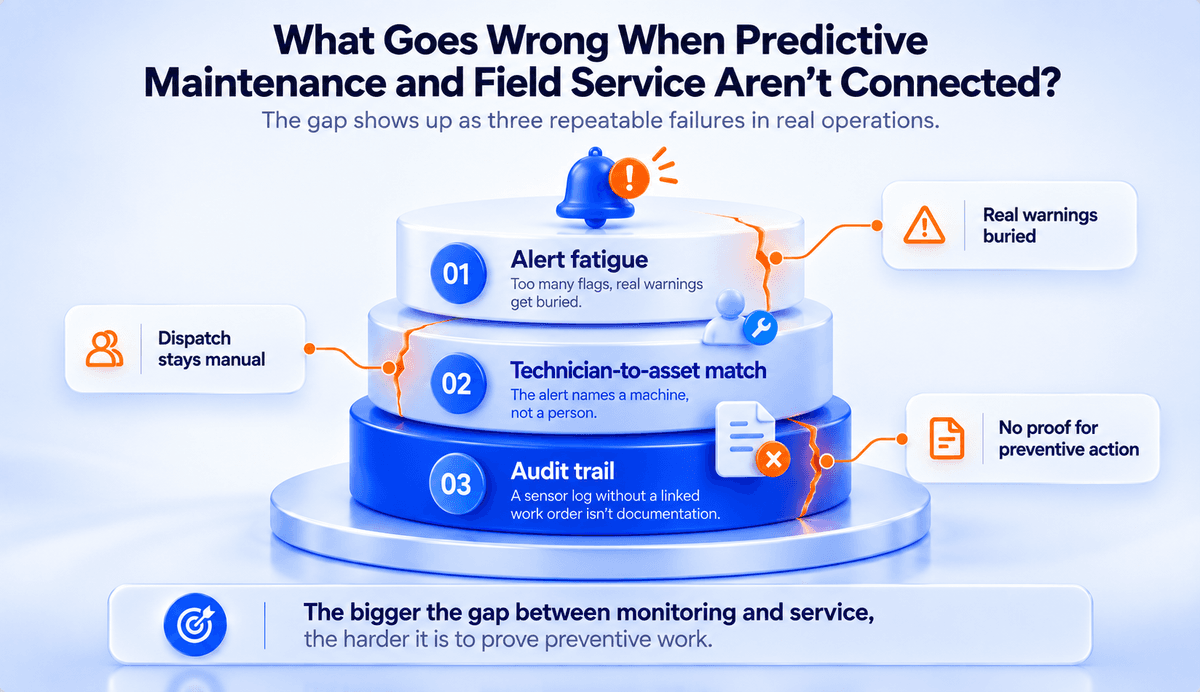
Three failure patterns show up repeatedly at manufacturing and equipment businesses running IoT monitoring without a connected field service system.
Alert fatigue. Sensors generate more flags than a supervisor can triage manually, so real warnings get buried with minor ones.
No technician-to-asset match. The alert names a machine, not a person, so dispatch still depends on someone remembering who last serviced it.
Broken audit trail. A sensor log with no linked work order does not count as documentation when an AMC contract asks for proof of preventive action.
Each traces back to buying the IoT layer and the field service layer as two separate decisions. That gap matters more across India's mid-market, where the Ministry of Finance's Economic Survey 2025-26 puts MSMEs at 31.1 percent of GDP, most without a planner to filter every alert manually.
What Does a Connected Predictive Maintenance Setup Look Like in 2026?
In 2026, most mid-market manufacturers are not buying a standalone predictive maintenance platform first. They are asking whether their existing field service system can ingest device data at all.
A working setup, in practice, follows four steps.
Confirm the IoT source. Identify which sensors or third-party platform is already generating the failure signal.
Connect it by API or webhook, not a manual export, into the system that manages field work.
Define the routing rule once, deciding which severity levels trigger an automatic work order versus a supervisor review.
Assign by skill and location, then track outcomes against the original alert.
IDC projects that agentic AI will account for more than 26 percent of worldwide IT spending by 2029, spending that increasingly covers the workflow layer between prediction tools and execution teams, not the models alone. For a Service Head evaluating vendors, the deciding question is rarely which platform has the smartest prediction model. It is which one already sits inside the system technicians use every day.
Why Should You Choose DGlide?
DGlide does not build the sensor network or the failure-prediction model, since that comes from a dedicated IoT vendor. What DGlide does is route the device data those platforms generate into a tracked field service workflow, so a prediction becomes an assigned job instead of a dashboard alert.
IoT and device data integration. DGlide FSM connects to external IoT feeds as a standard integration, alongside CRM, ERP, and ITSM systems.
No-code routing rules. Ops leads configure which alerts become work orders and which need supervisor review, without a developer.
SLA and escalation logic, with asset history on every job. A prediction with no response inside a set window escalates automatically, and technicians see prior repairs before they arrive.
DGlide already runs this workflow for machinery manufacturers managing AMC commitments across several sites. At Prompt Lasers, moving lead and service response into one connected system cut response time from over 40 minutes to 8, a gain that came from routing, not a smarter sensor.
If your IoT platform is already generating alerts nobody is systematically acting on, see how DGlide turns that signal into a tracked job.
Conclusion
Predictive maintenance software solves the forecasting problem, not the execution problem. Most of the value McKinsey and Gartner have documented in AI-driven maintenance comes from what happens after the alert, not the model that generated it.
For a Service Head or Ops Head evaluating this category, the practical next step is checking whether the operations platform already in place can turn an external sensor signal into a routed, tracked, closed work order. If it cannot, the prediction stays a dashboard, not a repair.
FAQs
Is predictive maintenance software the same as a CMMS?
No, predictive maintenance software and a CMMS solve different problems. A CMMS schedules and tracks maintenance work, including preventive tasks. Predictive maintenance software forecasts failures from sensor data. It typically still needs a CMMS or FSM system to act on that forecast.
What is sensor data in predictive maintenance?
Sensor data in predictive maintenance is the continuous stream of readings collected from a machine. Common examples include vibration, temperature, and pressure readings. These get compared against historical baselines to detect early wear. That comparison is what lets the software flag a likely failure early.
What are the three P's of maintenance?
The three P's of maintenance commonly refer to Predictive, Preventive, and Proactive strategies. Some frameworks add Planned maintenance as a fourth category. Predictive maintenance is generally the most advanced, since it reacts to real equipment condition.
Does DGlide provide the sensor-based prediction itself?
No, DGlide does not build IoT sensors or failure-prediction models. A dedicated IoT vendor supplies that data first. DGlide then turns it into a tracked job inside DGlide FSM.