No-code and low-code platforms let a business build software through visual configuration, drag-and-drop components, workflow builders, form designers, instead of writing it line by line, so an application that used to take months of development can go live in weeks. The distinction between the two is scope: no-code needs zero coding, low-code mixes visual building with optional custom code for edge cases.
For an IT Head evaluating this, the interesting question is not whether no-code works. It clearly does. It is who gets to build with it, and what happens six months after a business user builds their first app without IT ever reviewing it.
Gartner projects that the global low-code development market will reach $44.5 billion in 2026, growing at a 19 percent CAGR, with 70 percent of new enterprise applications expected to use low-code or no-code technology by 2026. This piece covers what no-code and low-code platforms actually do, the governance question most content skips, and where DGlide's no-code platform fits.
TL;DR
No-code and low-code platforms differ by scope: no-code needs zero coding, low-code mixes visual building with optional custom code.
The low-code market is projected to hit $44.5 billion in 2026, with 70 percent of new enterprise apps expected to use it.
Citizen-developer adoption is a genuine shift, but most content treats it as risk-free, when ungoverned no-code sprawl is its own new shadow IT problem.
No-code applies across ITSM, ITAM, CRM, HRMS, and field service, not just one department's workflow.
DGlide pairs no-code building with role-based access and audit visibility, not open building with no oversight.
What Are No-Code and Low-Code Platforms?
No-code and low-code platforms make application development accessible without deep programming skills, through visual interfaces where a user configures forms, workflows, and logic instead of writing them. A no-code platform requires no code at all. A low-code platform combines that visual building with the option to drop into custom code when a workflow needs it.
Both integrate with the enterprise systems a business already runs, CRM, ERP, ITSM, HRMS, so a sales, HR, or IT team can build a tailored application without waiting for a developer to be free. IT's role shifts from building every request to setting the guardrails other teams build inside.
The Citizen-Developer Risk Most No-Code Content Skips
Most no-code and low-code content treats the rise of the citizen developer as an unambiguous win, and skips what happens when a business user builds an app IT never reviewed. That gap is not hypothetical, it is the same shadow IT problem in a new form.
The problem: a business user building an app outside IT's visibility means nobody is tracking what data it touches, who can access it, or what happens when that person leaves the company.
The solution: no-code adoption needs the same governance a traditional IT rollout gets, role-based access, an audit trail, and a way for IT to see what has been built, without slowing down the person building it.
Kissflow frames this directly: shadow IT is both essential and dangerous, noting that the average data breach costs $4.35 million, and that governed low-code, not locked-down low-code, is the actual competitive differentiator.
Still letting no-code apps get built with no visibility into who built what? Talk to us for 15 minutes about governed no-code.
Why Are Businesses Adopting No-Code and Low-Code Now?
Businesses are adopting no-code and low-code now because traditional development can no longer keep pace with how fast a company needs to adapt, and the tools have matured enough to trust with real workflows, not just prototypes. That shift shows up in four concrete outcomes.
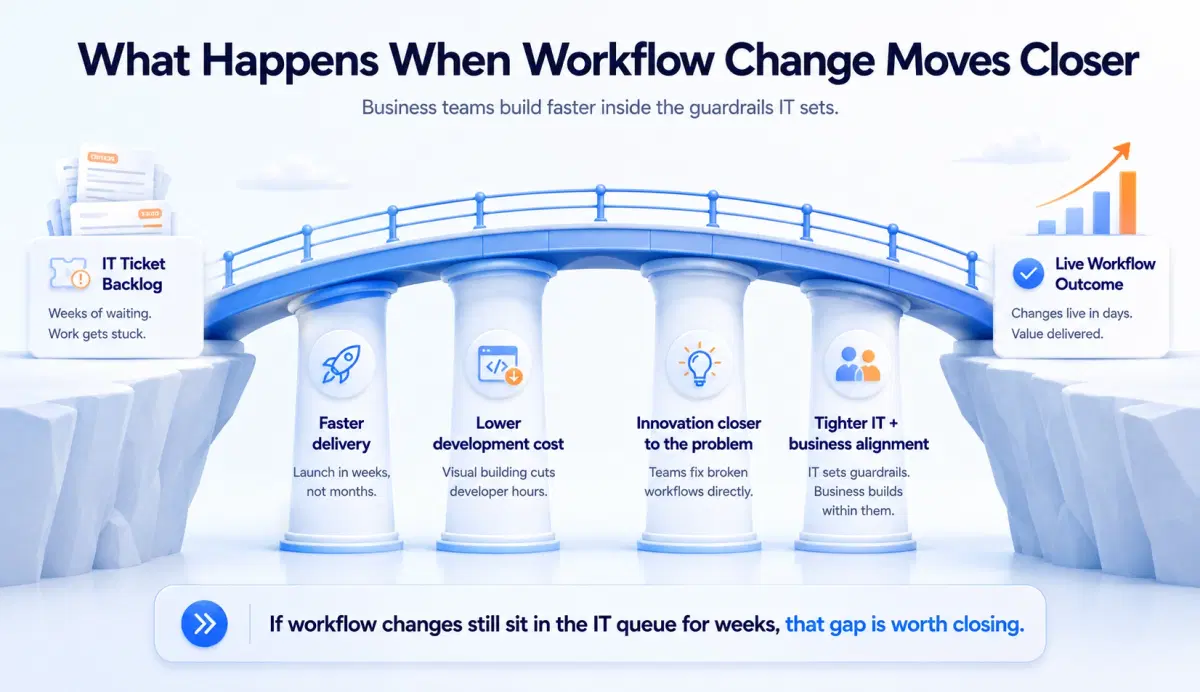
Faster delivery: An application that took months now launches in weeks, clearing the backlog IT could never fully staff for.
Lower development cost: Visual building reduces the developer hours a workflow change used to require.
Innovation closer to the problem: The person who feels a broken process daily can fix it directly, instead of writing a ticket and waiting.
Tighter IT and business alignment: IT sets the platform and guardrails, business teams build inside them, instead of IT building everything on request.
If your team is still filing a ticket and waiting weeks for a workflow change IT could hand off directly, that gap is worth closing. Ask us for a 15-minute walkthrough.
Where Does No-Code and Low-Code Actually Apply Across the Business?
No-code and low-code platforms apply across every department running a repeatable process, not just IT, and the specific use case changes what "no-code" needs to deliver in each one.
ITSM. Self-service portals and automated SLA escalations cut ticket resolution time without a developer configuring every routing rule.
IT asset management. Real-time tracking of hardware and software usage replaces a spreadsheet nobody keeps current.
CRM. Custom sales pipelines built by a sales operations lead, not a developer, adapt as the sales process actually changes.
HRMS. Onboarding and leave workflows automate without HR filing a change request every time a policy shifts.
Field service. Mobile apps built for a specific technician workflow, not a generic template, cut downtime and improve response time.
The common thread is that the team closest to the problem builds the fix, with IT setting the platform rather than building every request themselves.
Why Should You Choose DGlide?
If your team is evaluating no-code because business users keep waiting on IT for workflow changes IT never has time for, DGlide gives them a builder with governance already built in, not bolted on afterward.
Drag-and-drop app and form building lets a business user create what they need without a developer.
Role-based access and real-time data sync mean IT keeps visibility into what gets built and who can see it.
The same no-code engine spans ITSM, CRM, and field service, so a workflow built for one team can connect to what another team already uses.
DGlide deploys in days to weeks, at roughly 40 percent lower cost than legacy platforms, with no specialist required. Pricing does not scale with every add-on.
DGlide fits mid-market teams that want no-code building with IT still able to see and govern what gets built, not open building with zero oversight. Book a free 15-minute demo to see it built on your own workflow.
Conclusion
No-code and low-code platforms are not just a faster way to build software, they are a shift in who builds it, and that shift only works well when governance moves with it. A business user building an app IT cannot see is not empowerment, it is a new kind of risk with a friendlier interface.
For an IT Head evaluating this now, the practical move is to ask not just how fast a platform lets someone build, but how visible that building stays to the team responsible for what happens after.
FAQs
What is the difference between no-code and low-code platforms? No-code platforms require zero coding to build an application. Low-code platforms combine visual building with optional custom code for edge cases. Both let non-developers build working applications.
Is it safe to let business users build their own applications with no-code tools? It is safe when the platform includes role-based access and audit visibility for IT. Ungoverned no-code building creates the same risk as unmanaged shadow IT. Governance should move with adoption, not lag behind it.
Which business functions benefit most from no-code and low-code platforms? ITSM, IT asset management, CRM, HRMS, and field service all benefit, since each runs repeatable workflows a business user can configure directly. The common requirement is a repeatable process, not a specific department.
Does DGlide give IT visibility into what business users build? Yes, DGlide pairs no-code building with role-based access and real-time data sync, so IT retains visibility into what gets built. Workflow changes are not black boxes outside IT's control. Governance and building speed are not a trade-off on DGlide's platform.