ITSM, or IT Service Management, is the end-to-end process of designing, building, delivering, and managing IT services for an organization, so that every piece of technology, from a laptop to a cloud application, stays aligned with what the business actually needs. It replaces ad-hoc firefighting with structured, repeatable workflows, usually guided by a framework like ITIL.
For an IT Head evaluating this, the practical distinction is not whether a tool has a ticketing system. Most do. It is whether incident, problem, change, and request management actually work together as one process, or as four disconnected habits that happen to share a login screen.
A study found that the global ITSM market is projected to grow from $15.44 billion in 2025 to $57.93 billion by 2035. This piece covers what ITSM actually includes, the frameworks behind it, and where AI is genuinely changing it, including where DGlide's ITSM platform fits.
TL;DR
ITSM is defined by four core processes working together, incident, problem, change, and request management, not by having a ticketing tool.
ITIL is the most common framework for implementing ITSM, but it is a guide, not the software itself.
AI-powered service desks are frequently marketed as deflecting 50-75% of tickets, a figure that drops meaningfully under stricter, audited definitions.
Downtime is a business cost problem, not just an IT metric, which is why ITSM outcomes should be measured in business terms.
DGlide applies AI to ITSM through no-code workflows, not through unverified deflection claims.
What Is ITSM?
ITSM stands for IT Service Management, the approach an organization uses to plan, deliver, support, and improve the way technology serves the business. It covers the full lifecycle of a service, not just the moment something breaks, from how a request gets logged to how a recurring problem gets permanently resolved.
Modern ITSM leans heavily on AI, automation, and self-service portals to resolve requests faster and reduce manual workload, but the underlying discipline is decades old. The technology changes faster than the four processes it is built on.
What Are the Core Processes of ITSM?
ITSM is built on four core processes, and a platform that only does one of them well is not a complete ITSM solution. Each process answers a different operational question.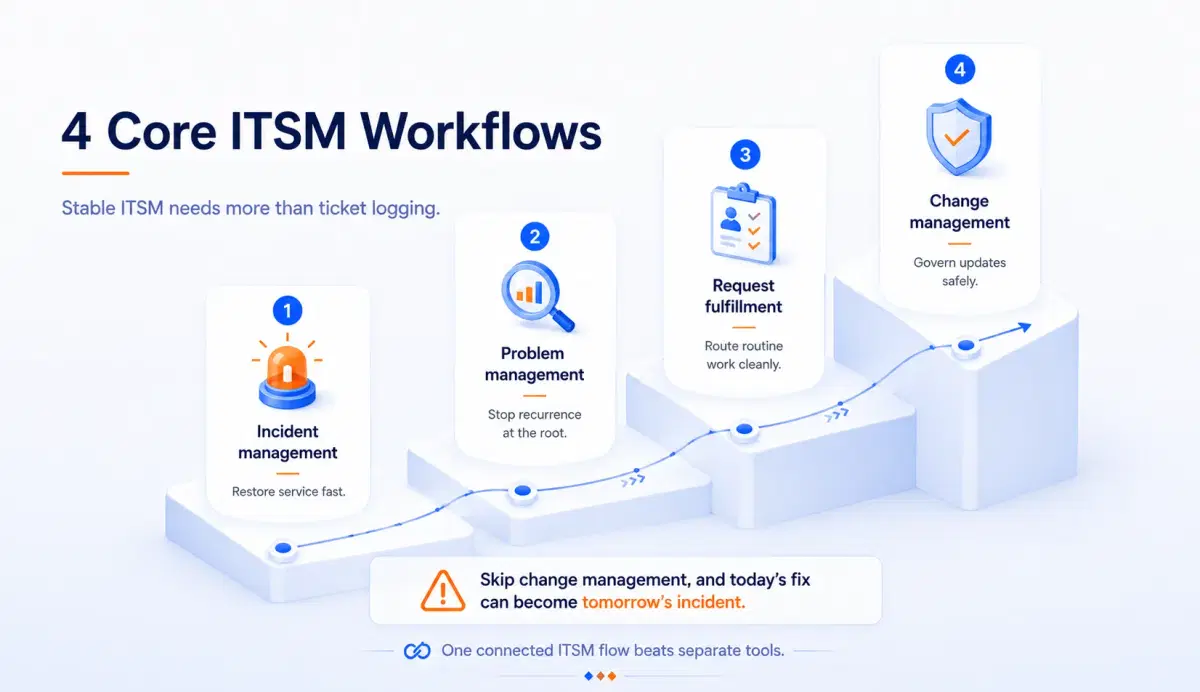
Incident management. Restores a service to normal as quickly as possible after an unexpected outage or disruption, without necessarily fixing the underlying cause yet.
Problem management. Investigates and eliminates the root cause behind incidents, so the same outage stops recurring every few weeks.
Request fulfillment. Handles routine, expected requests, a password reset, new software, a laptop, through a standard, repeatable path.
Change management. Standardizes how changes to IT infrastructure get approved and rolled out, so updates do not become their own source of incidents.
None of these four exist in isolation. A change that skips this process is often the next incident, and an incident that skips problem management is next month's repeat ticket.
Still tracking incidents in one tool and change approvals in an email thread? See what one connected ITSM workflow looks like in 15 minutes.
What Frameworks and Tools Support ITSM?
ITIL is the most widely used framework for implementing ITSM, providing structured guidance across the full service lifecycle, though COBIT and ISO/IEC 20000 serve similar roles in specific contexts. A framework is not software, it is the rulebook a platform is configured to follow.
ITIL (IT Information Technology Infrastructure Library). The dominant framework, covering service strategy, design, transition, operation, and continual improvement.
COBIT. Focuses more on IT governance and risk alignment with business objectives than day-to-day service processes.
ISO/IEC 20000. An international standard for service management, often used as a certification target rather than a working framework.
Most modern ITSM platforms implement these frameworks through configurable workflows rather than requiring a team to memorize a manual.
Why "AI-Powered ITSM" Claims Deserve a Second Look
Most ITSM vendors, including a lot of content on this exact topic, market AI deflection rates that do not hold up under a stricter definition. An analysis found that vendor-published case studies commonly cite 50 to 75 percent ticket deflection, while Gartner's stricter standard, full resolution with no human agent and no reopened ticket within 72 hours, puts the industry average closer to 20 to 30 percent, with 40 to 60 percent only for best-in-class deployments.
The problem: a vendor counting "the user did not open a new ticket in 24 hours" as a resolved case is measuring something different from a request that is actually closed.
The solution: judge an AI-powered ITSM claim by what counts as resolved, not by the headline percentage, and ask what happens to the requests that are not.
This is not a reason to distrust AI in ITSM. It is a reason to ask a vendor exactly which definition their number uses before comparing it to anyone else's.
Why Does ITSM Matter for the Business, Not Just IT?
ITSM matters beyond the IT department because downtime and slow request handling are business costs, not just IT metrics. 91 percent of mid-sized and large enterprises report downtime costs exceeding $300,000 per hour, with 44 percent reporting costs above $1 million per hour.
That is the real reason incident and change management get formalized. A structured process is not bureaucracy for its own sake, it is what keeps an outage from turning into the expensive kind.
What's Actually Changing in ITSM in 2026?
What is genuinely changing in ITSM in 2026 is not the four core processes, it is how much of the routine work around them gets handled without a person touching every step. Three shifts matter more than the "AI-powered" label itself.
Predictive detection over pure reaction. Systems increasingly flag a recurring pattern before it becomes a full incident, shifting some problem management earlier in the cycle.
Self-service that actually resolves things. The gap in the section above matters here specifically, self-service is only valuable at the resolution rate it is honestly measured at.
Experience measured alongside speed. Some organizations track user satisfaction and clarity of communication alongside raw resolution time, not as a replacement for it.
If your last "AI-powered" service desk pitch didn't specify how deflection was measured, that is worth asking before the next one. Talk to us for 15 minutes about what to ask.
Why Should You Choose DGlide?
If you are evaluating ITSM because your incident, problem, change, and request processes live in separate habits rather than one system, DGlide brings all four together on one no-code platform.
Incident, problem, change, and request management share the same workflow engine, not four disconnected modules.
Workflow changes are configured by a service manager directly, not scripted by IT or a vendor partner.
AI-assisted routing and predictive flags are built in, with every automated action logged and traceable.
DGlide typically deploys in days to weeks, at roughly 40 percent lower cost than legacy ITSM vendors, with no specialist required to configure it. Pricing does not scale with every add-on.
DGlide fits mid-market teams that want ITSM, facilities, and branch operations on one platform, not enterprise programs needing deep CMDB depth. Book a free 15-minute demo to see your own ITSM workflow built live.
Conclusion
ITSM is not defined by having a ticketing tool, it is defined by incident, problem, change, and request management working as one connected process. AI changes how much of that process runs without a person, but it does not replace the underlying discipline.
For an IT Head evaluating this now, the practical move is to ask what a vendor's numbers actually measure before comparing them, and to judge a platform on whether all four core processes share one system, not four separate habits.
FAQs
What does ITSM stand for?
ITSM stands for IT Service Management. It covers designing, delivering, and improving IT services for a business. The goal is aligning technology with business needs, not just fixing outages.
What is the difference between ITSM and ITIL?
ITSM is the overall discipline of managing IT services end to end. ITIL is the most common framework used to implement it. ITSM is the strategy, ITIL is the guidance for executing it.
What are the core processes every ITSM platform should cover?
The four core processes are incident, problem, change, and request management. Incident management restores service quickly. Problem management fixes the root cause behind repeat incidents.
Is DGlide a good ITSM platform for mid-market companies?
Yes, DGlide fits mid-market teams needing incident, problem, change, and request management on one no-code platform. It is not built for enterprise-scale CMDB programs. Deployment typically takes days to weeks.