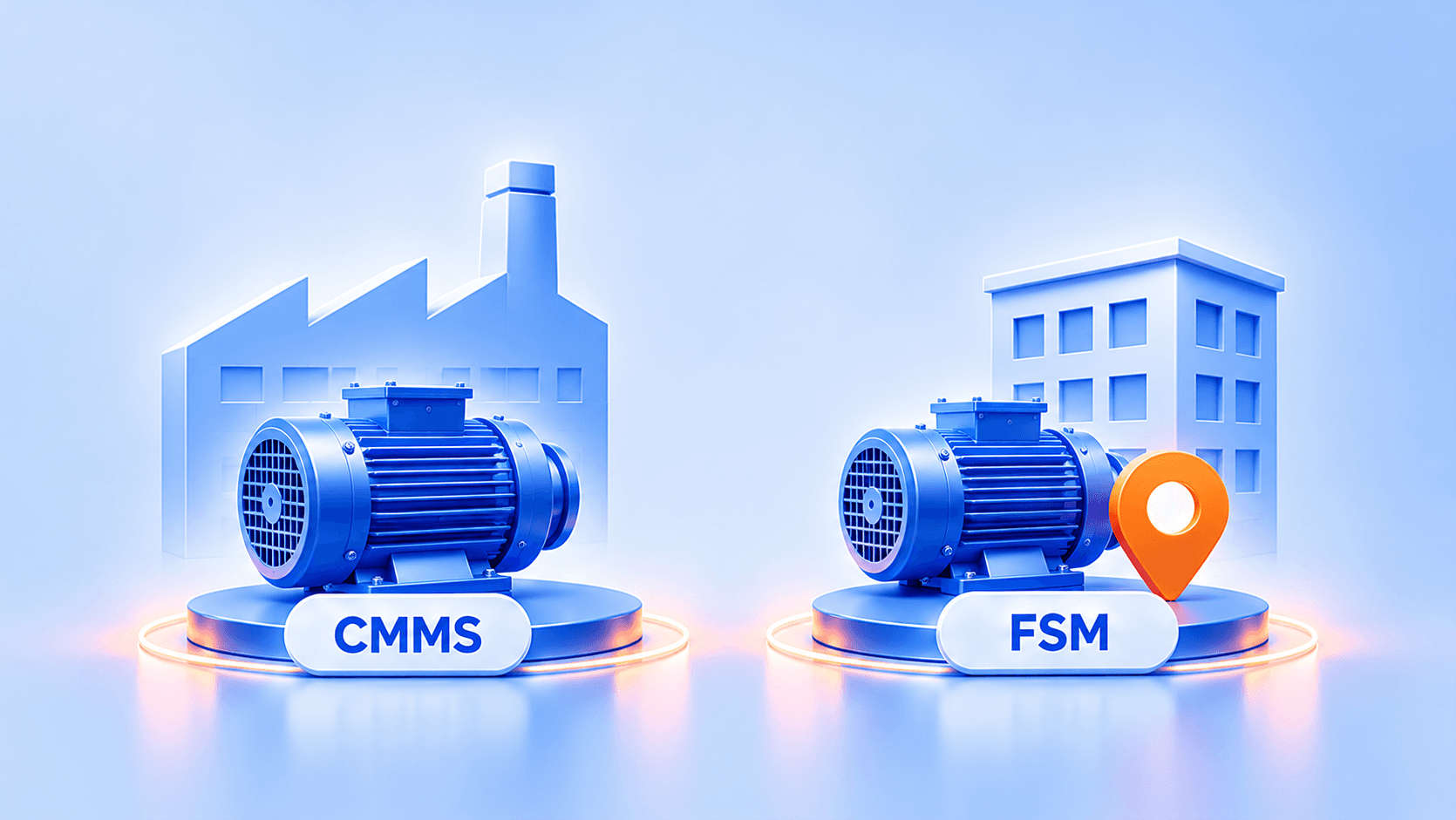
Quick Answer: The difference between field service management and a CMMS is whose machine the work is on. A CMMS maintains machines your company owns, while field service management (FSM) services machines your customers own, under a warranty or AMC that promises a response.
Key points covered in this article:
The one test that separates CMMS and FSM
Why "one site or many" misleads buyers
Where SAP fits in the comparison
When an equipment maker needs both
Field service management vs CMMS is a choice between two record systems with different owners. A CMMS keeps the history of assets you own, and field service management keeps the history of assets your customers own, plus the contract that covers them. Equipment makers that pick the wrong one usually find out at the first AMC renewal.
In the machinery and equipment businesses we work with, the trouble starts quietly. The plant team already runs maintenance in SAP or a CMMS, sales books orders in Zoho or Tally, and the service head is told to log customer breakdowns "in the same system". Six months later, AMC dates live in Excel and engineer visits live in a WhatsApp group.
Ask your service head four questions about last month. A service business should answer each in a minute.
Which customer machines are under warranty, under AMC or out of cover today?
How many complaints missed the response time promised in the AMC?
Which engineer visited which machine, and did the customer confirm the fix?
Which AMCs expire in the next 90 days, and what did each cost to serve?
If each answer needs an Excel hunt or a call to an engineer, the gap is not effort. The plant's CMMS was never built to hold a customer, a contract or a promise, and no amount of discipline adds those fields.
A study by McKinsey found that industrial companies with a high service focus generated 1.7 times the total shareholder return of product-focused peers. This guide builds on our guide to machine maintenance tracking software, which compares CMMS with EAM.
TL; DR
A CMMS maintains assets you own, and FSM services assets your customers own.
The real test is the customer and the contract, not the number of sites.
A multi-site CMMS still has no field for AMC cover or a response promise.
SAP is an ERP whose maintenance orders are built for your own plant.
A manufacturer with a plant and an installed base usually needs both systems.
Choose field service management when service is sold, promised and renewed.
What is the difference between CMMS and field service management?
A CMMS (computerised maintenance management system) schedules and records maintenance on equipment the company owns, inside its own plant or buildings. Field service management schedules, dispatches and records service on equipment customers own, at customer sites, against a warranty, AMC or paid call.
SAP's own explainer names the users of a CMMS as maintenance planners, schedulers and technicians. None of those roles answers a customer's call.
Question | CMMS | Field service management |
Whose machine? | Yours | Your customer's |
Where is the work? | Your plant or buildings | Customer sites across cities |
What triggers work? | PM plan or a breakdown on your line | Customer complaint, AMC visit due, installation |
What is promised? | Uptime to your production head | Response time written into an AMC |
What ends a job? | Machine back in production | Customer confirms the fix |
What follows the job? | Spares and cost booked to your plant | Visit counted against the AMC, renewal, invoice |
Who uses it daily? | Maintenance planner, plant technicians | Service head, coordinator, field engineers |
Both systems hold work orders and asset history, which is why vendors blur them. The rows after "whose machine" are the real field service management vs CMMS split.
Why is "one site or many sites" the wrong test?
 Most field service management vs CMMS comparisons split the two by location, a single facility against many customer sites. That test fails equipment companies, because multi-site CMMS products exist and many plants run five locations. The test that holds is whether a customer and a contract sit on the other side of the work order.
Problem. Customer complaints go into the plant CMMS as internal breakdowns, so the customer's name sits in a free-text note.
Fix. Log each complaint against the customer's machine, with its serial number and cover status.
Problem. The AMC promises a 24-hour response, but the CMMS clock measures repair time on your own line.
Fix. Start the clock when the customer calls and escalate before the promised time runs out.
Problem. Visits are recorded, but nobody can say which AMC each visit was used against.
Fix. Count every visit against its contract, so the renewal quote uses real numbers.
📊 **A water technologies OEM that mapped its installed base generated more than $350 million in aftermarket leads across 45,000 customers.** A plant CMMS has no customer list to map. Per McKinsey, March 2025.
A CMMS can tell you the pump was serviced. It cannot tell you the customer is about to stop paying for it.
Logging customer breakdowns in your plant's CMMS? See how DGlide ties each complaint to the customer's machine and AMC
Is SAP a CMMS or an ERP?
SAP is an ERP, not a CMMS, but its plant maintenance module does CMMS work for a company's own equipment. SAP itself notes that most medium-sized and large companies now run maintenance through enterprise asset management connected to the ERP, rather than a standalone CMMS.
What SAP's maintenance orders cover
They cover equipment in your plant, planned by a maintenance planner and costed to your own cost centres. That is CMMS work running inside an ERP, which is why many Indian plants simply call it "SAP PM".
Where customer service sits
In most mid-size Indian manufacturers, SAP holds the customer, the order and the invoice. The AMC's response time, the visit count and the customer's sign-off sit outside it, in Excel and WhatsApp.
What this means for a mid-size equipment maker
Running SAP in the plant does not mean the service team should work in plant maintenance screens. The real choice is a service system that reads the customer and machine master from SAP, or service squeezed into screens built for planners.
For SAP plants, field service management vs CMMS is really service against plant maintenance. Field service management adds the customer promise and the clock that plant maintenance was not designed to hold.
Can one company need both a CMMS and field service management?
Yes. A manufacturer that runs its own plant and services machines at customer sites has two maintenance jobs, and each needs its own record. The plant team needs a CMMS for line uptime, and the service team needs field service management for customer machines, AMCs and response promises.
Take a typical case from the machinery businesses we speak with. A Pune machine maker runs one factory with 60 production machines and has 1,200 of its machines installed at customers across Maharashtra, Gujarat and Karnataka.
Plant side. Preventive maintenance on 60 machines, spares and line downtime.
Runs in the CMMS or SAP, owned by the maintenance planner.
Service side. 1,200 customer machines, 400 under AMC, three engineers per region.
Runs in field service management, owned by the service head.
Shared data. The machine master, spares stock and invoices.
Passed between the two through an ERP integration, not retyped.
📊 **A water treatment company's digital scheduling tool raised technician capacity by 40 percent and cut overtime by 6 percent.** That gain came from scheduling engineers across customer sites. Per McKinsey, March 2025.
For this company, field service management vs CMMS is not a choice at all. A machine's service life starts on the day it is commissioned at the customer, and our guide to equipment installation and service tracking covers that handover.
Which one does an equipment company running AMCs need?
An equipment company that sells AMCs settles field service management vs CMMS in favour of FSM for its service team, whatever runs in the plant. If service is sold, promised and renewed, every job needs three records: a customer, a contract and a clock.
A study by Gartner found that over 50 percent of customer service organisations will double their technology spend by 2028. In 2026, the question for equipment makers is which records that spend should buy.
You sell AMCs or extended warranties. Each machine then needs its cover status and entitlement on the record.
You promise a response time. The clock must start at the customer's call, not at the planner's order.
Engineers travel to customers. Dispatch then needs location, skills and today's workload, updated from the engineer's phone.
Customers ask for proof. The job should close with the customer's confirmation, not a technician's tick.
Renewals drive revenue. Visit counts and response records must feed the renewal quote.
If none of these apply and your machines never leave your plant, a CMMS is the right tool. If two or more apply, start with our checklist for AMC management software.
AMC renewals still tracked in Excel? See how renewal windows surface on their own in DGlide
Why Should You Choose DGlide?
DGlide runs field service for equipment makers and AMC-driven businesses on a configurable operations platform. The customer, the machine and the contract share one record, linked to the ERP your plant already runs.
Work Order Management. Calls, emails and WhatsApp messages become work orders carrying the machine, customer and history.
SLA & Escalations. The clock starts at the call and escalates before the AMC promise is missed.
Renewals & AMC Tracking. Renewal windows surface automatically, beside each machine's service history.
Integrations. ERP and accounting links keep the machine master and billing in step.
Prompt Lasers, a DGlide customer, cut response time from over 40 minutes to 8 by running every project and complaint in one system. Go-live takes weeks, with pricing fixed to the agreed scope.
Versus the plant CMMS. Customer complaints get a customer, a contract and a clock.
Versus Excel and WhatsApp. Cover status, visits and renewals sit on one machine record.
To see it with your installed base, book a free 15-minute demo.
Conclusion
A CMMS and field service management both hold work orders, but they answer to different people. The CMMS answers to your production head, and field service management answers to the customer who signed the AMC.
Keep the plant on the system built for the plant, and give service the customer, contract and clock it is missing. Start with the machines whose AMCs expire next quarter, and list what each one needs before the AMC renewal conversation.
FAQs
Are CMMS and EAM the same?
CMMS and EAM are not the same. A CMMS runs maintenance work orders and schedules. EAM also covers an asset's whole life and its costs. Both serve assets the company owns.
What is the difference between CRM and FSM?
CRM manages the customer relationship and the sale. FSM manages the service work after the sale. Equipment firms need both on one machine record. See our field service CRM shortlist.
Can a CMMS manage AMC contracts?
A CMMS cannot manage AMC contracts well. It has no field for customer cover or entitlement. It also cannot count visits against a contract. Field service management holds all three.
Does a small equipment company need field service software?
A small equipment company needs it once it sells AMCs. Fifty machines under contract already outgrow Excel. Missed visits then become missed renewals. Start with machines under active cover.