
Proactive service means acting before a customer notices a problem, predicting, preventing, and resolving an issue before it becomes a complaint, not just responding to that complaint faster once it arrives. The distinction matters because most content, and most tools, labeled "proactive" are actually reactive service running on a shorter timer.
For a service or operations lead, the useful test is not whether a system responds quickly. It is whether the customer ever had to raise the issue at all.
A study by McKinsey found that a comprehensive, analytics-based approach to customer management can reduce churn by as much as 15 percent, by catching the signals of a problem before a customer disengages, not after. This piece covers what genuinely proactive service requires, where most "proactive" content actually describes faster reactive service, and where DGlide fits.
TL;DR
Proactive service means acting before a customer raises an issue, not responding faster once they do.
Analytics-driven churn management can cut churn by up to 15 percent, by catching disengagement signals early.
Most content lists AI chatbots and self-service as "proactive," when both usually respond to a customer who already has a problem.
Genuinely proactive service depends on connected data, an issue has to be visible to the system before a person notices it.
DGlide connects CRM, FSM, and ITSM data so a pattern shows up before a customer has to report it.
What Is Proactive Service, Actually?
Proactive service is anticipating and resolving a customer's need before they have to ask, built on monitoring patterns in the data a business already has, not on responding faster after a request comes in. The mechanism is prediction, not speed.
That distinction is not academic. A support team that resolves tickets in ten minutes is fast. A team that fixes the underlying issue before the customer notices anything went wrong is proactive. Only one of those requires the customer to have a bad experience first.
Where Most "Proactive Service" Content Actually Describes Faster Reactive Service
Most proactive service content lists AI chatbots, self-service portals, and automated alerts as proactive tactics, and most of those tools activate only after a customer has already hit a problem. A chatbot answering a question the customer typed is reactive service with a faster response time, not proactive service.
The problem: labeling every automated touchpoint "proactive" blurs the one distinction that actually matters, whether the system acted before or after the customer noticed something was wrong.
The solution: judge a "proactive" claim by asking what triggered the action. If a customer had to contact the business first, it is reactive, regardless of how fast or automated the response was.
A genuinely proactive alert, a predictive maintenance flag before equipment fails, an account manager reaching out before a renewal risk shows up in a support ticket, requires the business to see the pattern before the customer does. That only works when the underlying data is actually connected.
Still calling something proactive because it is automated, when the customer still had to reach out first? Talk to us for 15 minutes about what genuinely proactive looks like.
How Does Proactive Service Actually Build Customer Loyalty?
Proactive service builds loyalty because it removes effort from the customer's side entirely, not because it resolves their problem quickly. A customer who never had to notice a problem forms a different kind of trust than one whose fast complaint got resolved well.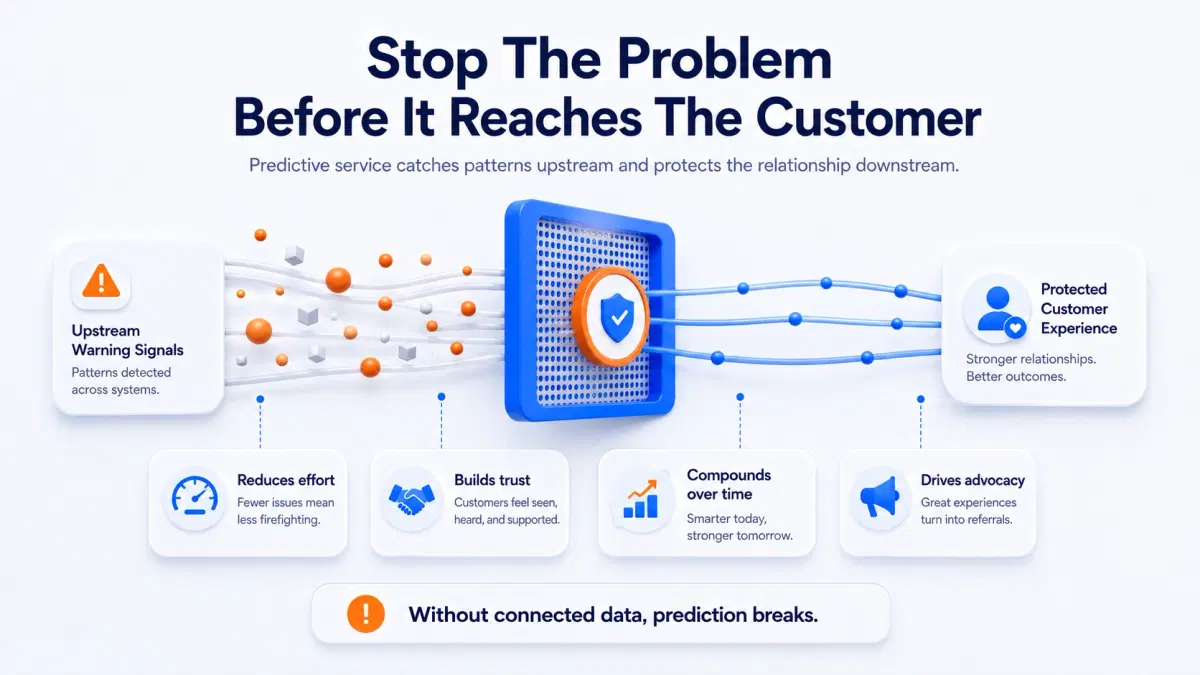
Reduces effort. The customer spends zero time raising an issue that never reaches them in the first place.
Builds trust through attentiveness. Being contacted before something breaks reads as care, not customer service.
Compounds over time. Frederick Reichheld's original research at Bain found that a 5 percent improvement in customer retention increases profits by a range depending on industry, from roughly 25 percent in financial services to 85 percent in banking, a wide range that depends heavily on the business, not a flat number.
Drives advocacy. A customer who was protected from a problem, rather than rescued from one, is the one who tells other people about it.
One honest note: none of this works without connected data. A predictive alert is only as good as whether the system generating it can actually see the pattern.
Why Should You Choose DGlide?
If your "proactive" service today means responding faster after a customer reaches out, DGlide connects CRM, field service, and IT ticketing data so a pattern is visible before that contact happens.
CRM and field service data share the same record, so a recurring service issue shows up as a pattern, not three separate tickets.
ITSM and FSM together mean an equipment or service trend gets flagged before it becomes a customer-facing complaint.
Analytics and reporting surface disengagement or risk signals from data the business already has, not a separate monitoring tool bolted on.
DGlide deploys in days to weeks, at roughly 40 percent lower cost than legacy platforms, with no specialist required. Pricing does not scale with every add-on.
DGlide fits mid-market teams that want genuinely predictive signals from connected CRM, FSM, and ITSM data, not a chatbot rebranded as proactive service. Book a free 15-minute demo to see it on your own customer data.
Conclusion
Proactive service is not a faster reply to a customer who already has a problem, it is preventing that customer from ever having the problem reach them. Most content, and a lot of tooling, calls automation proactive when it is really reactive service on a shorter clock.
For a service lead evaluating this now, the honest test is simple: check whether the last "proactive" alert your team sent actually went out before the customer contacted you, or right after.
FAQs
What is the difference between proactive and reactive customer service? Reactive service responds after a customer raises an issue, however fast that response is. Proactive service resolves or prevents the issue before the customer ever has to ask. The difference is what triggers the action, not the speed of it.
Does proactive service actually reduce customer churn? Yes, analytics-driven approaches to catching disengagement signals early can reduce churn by up to 15 percent. The key is acting on the signal before a customer disengages, not after. Speed alone does not achieve this without the right data connected.
Are AI chatbots an example of proactive service? Usually not, since most chatbots respond to a question a customer already typed. That is faster reactive service, not proactive service. A chatbot becomes proactive only when it initiates contact based on a predicted issue, not a customer's message.
How does DGlide support proactive service specifically? DGlide connects CRM, field service, and ITSM data so a recurring issue or risk pattern is visible before a customer reports it. Analytics and reporting surface those signals from data the business already has. It is not a separate monitoring tool bolted onto existing systems.