Quick Answer: The best field service software for HVAC companies matches technician dispatch, AMC contract tracking and mobile job data to how a specific contractor's crew actually operates, not to a generic industry template.
Key points covered in this article:
How we evaluated FSM tools for HVAC operations
The shortlisting mistake that costs contractors flexibility
Core features every HVAC FSM platform needs
Full comparison: ServiceTitan, FieldEdge, Zoho FSM and more
Why a configurable platform fits growing HVAC operations
The best field service software for HVAC companies depends less on brand recognition than on whether the tool matches how a specific contractor dispatches technicians and tracks AMC renewals. Vertical branding gets a platform onto a shortlist. It does not guarantee the workflow underneath fits.
HVAC operations leaders in 2026 run a mix of residential tune-ups, commercial mechanical contracts and AMC-based maintenance plans - and that mix is shifting: preventive maintenance contracts captured 39% of total U.S. HVAC services revenue in 2025, per Mordor Intelligence's HVAC Services Market Report. Most contractors still coordinate technicians through a whiteboard, a shared spreadsheet or three disconnected apps.
Most still coordinate technicians through a whiteboard, a shared spreadsheet or three disconnected apps. Certification records, equipment history and invoicing rarely live in one place.
This guide compares the tools that show up first for HVAC field service software and explains why a configurable platform sometimes outperforms a fixed vertical tool. It also covers the shortlisting mistake most HVAC contractors make before they've requested a single demo.
TL;DR
Vertical branding on an FSM tool signals relevance, not configurability: check the second before trusting the first.
Contract mix, not feature count, should set the shortlist: AMC-heavy shops need different dispatch logic than flat-rate residential shops.
Mobile access to equipment history matters more than a long feature list for technicians doing repeat commercial visits.
A tool an operations manager can reconfigure alone outlasts one that needs a developer for every workflow change.
DGlide fits contractors who've outgrown spreadsheets but don't want a rigid, preset HVAC template.
How We Evaluated the Best FSM Software for HVAC Companies
We evaluated each platform against how HVAC contractors actually run jobs: dispatch flexibility, AMC contract handling, mobile field access and accounting sync. Marketing pages were checked against publicly available product documentation, not vendor claims alone. Pricing was checked against listed 2026 tiers where vendors publish them.
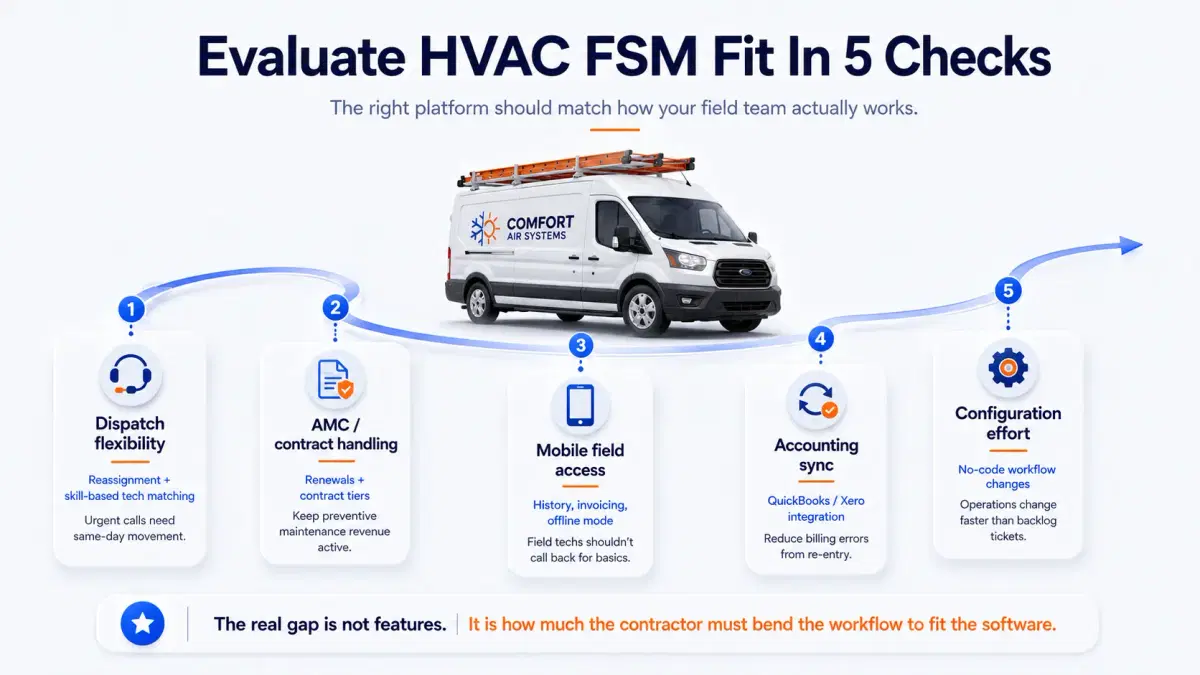
To separate genuinely HVAC-ready tools from general field service management platforms with an HVAC landing page bolted on, we evaluated each option against five criteria that actually matter to HVAC contractors day-to-day.
1. Dispatch Flexibility
We checked for drag-and-drop reassignment and skill-based technician matching. This matters because emergency AC-down calls need same-day reshuffling, not next-day slots - a tool that can't handle rapid reassignment doesn't fit how HVAC work actually flows.
2. AMC/Contract Handling
We checked for auto-renewal reminders and support for tiered contract levels. Preventive maintenance is a major recurring revenue stream for HVAC businesses, and that revenue depends entirely on renewals not slipping through the cracks.
3. Mobile Field Access
We checked for equipment history, digital invoicing, and offline capability. Technicians need to pull up nameplate details and service history on the spot, without calling the office every time they're missing information.
4. Accounting Sync
We checked for QuickBooks or Xero integration, and whether it was native versus a third-party connector. Manual invoice re-entry is where most billing errors start, so this integration matters more than it might seem.
5. Configuration Effort
We checked whether changes could be made no-code or required developer involvement. Contract structures and service areas tend to change faster than development backlogs can keep up with.
None of the six named competitors failed outright on these criteria. Where they differ is in how much a contractor has to bend their actual workflow to fit the software's built-in assumptions.
How Should HVAC Companies Choose FSM Software?
HVAC companies should choose FSM software by starting with their contract mix, not the feature list. A residential-only shop running flat-rate jobs needs different dispatch logic than a contractor managing 200 commercial AMC accounts alongside one-off repairs.
Four questions decide the shortlist before a single demo call happens.
What share of revenue comes from AMC versus one-off repair calls? A contract-heavy business needs automated renewal tracking more than a fast quoting tool.
How many technicians need mobile access to equipment history? A two-truck operation can survive on paper for longer than a twenty-truck one.
Does dispatch need to reassign jobs mid-day or is next-day scheduling enough? Emergency HVAC calls punish tools built only for scheduled maintenance visits.
Who updates the workflow when a process changes: a developer or the operations manager? This answer determines whether the tool scales with the business or becomes a ticket queue of its own.
Contractors who answer these honestly usually end up with a shorter, more accurate shortlist than one built from a "best of 2026" listicle.
The Mistake Most FSM Shortlists Make
The mistake most HVAC FSM shortlists make is assuming a tool built specifically for HVAC will automatically fit their operation. Vertical-specific branding signals relevance: it does not signal configurability and those are different things entirely.
ServiceTitan and FieldEdge both ship with strong, opinionated defaults: flat-rate price books, standard dispatch flows, preset service agreement templates. For a contractor whose AMC tiers, technician certifications or regional pricing don't match those defaults, the workaround usually lands back in a spreadsheet running alongside the software the contractor just paid for.
That is the actual cost of choosing on vertical branding alone: paying for a specialized tool and still maintaining a manual process next to it. A platform built to be reconfigured, rather than pre-built for one workflow, avoids that duplication.
Still forcing your AMC renewals into a spreadsheet because your FSM tool only handles standard dispatch? See how a configurable workflow handles it instead.
What Core Features Should HVAC FSM Software Have?
HVAC FSM software needs six specific capabilities to be useful beyond basic scheduling: real-time dispatching, AMC tracking, mobile field access, accounting sync, equipment history and technician certification tracking. Missing any one of these usually shows up as a manual workaround within the first quarter of use.
Job Dispatching
Dispatch needs drag-and-drop reassignment and technician skill matching, not just a calendar view. An emergency AC failure in July should be able to bump a routine filter-change visit without a phone call to every technician on the board.
AMC and Contract Tracking
Annual maintenance contracts need automated renewal reminders and support for multiple contract tiers. A contractor with residential, light-commercial and full-mechanical AMC levels needs the software to track each tier's terms separately, not one generic "service agreement" field.
Contractors relying on manual tracking routinely lose renewals to simple oversight - automated reminders push renewal rates into the 80–90% range for top-performing contractors, a gap manual tracking rarely closes on its own.
Mobile Field Access
Technicians need equipment history, asset details and digital invoicing available on a phone, including when signal drops mid-job.
Accounting Sync
Native QuickBooks or Xero integration matters more than a long list of accounting partners a contractor will never use. Manual re-entry between the FSM tool and the accounting system is the single most common source of billing disputes.
Equipment and Asset History
Technicians need to see a unit's full service record, including who serviced it last and what parts were used. This detail turns a diagnostic visit into a five-minute check instead of a repeat call.
Technician Certification Tracking
HVAC-specific certifications, EPA refrigerant handling among them, need to sit inside the dispatch logic itself. Software that can't check certification before assigning a job creates compliance exposure that no dispatcher should be catching manually.
Best FSM Software for HVAC Companies Compared
Software | Best Suited For | Key Strength | Configuration Effort |
ServiceTitan | Large HVAC operations (25+ technicians) | Deep reporting, marketing and financing tools | High - built for scale, not flexibility |
FieldEdge | Growing residential and commercial contractors | Native HVAC workflow templates | Medium - strong out of the box, rigid past that |
DGlide | Growing HVAC operations with non-standard AMC or dispatch needs | No-code configuration without a developer | Low - built to be reconfigured, not templated |
Zoho FSM | Small-to-mid HVAC businesses already on Zoho | Affordable ecosystem integration | Medium - tied to broader Zoho suite |
SimPRO | Mid-to-large mechanical contractors | Handles HR and billing alongside dispatch | High - comprehensive but heavy to set up |
BuildOps | Commercial mechanical service divisions | Built for project-based commercial work | Medium - commercial focus limits residential fit |
Thermal Grid | Midsize teams (5-50 technicians) | Certification-based auto-assignment | Medium |
Why Should You Choose DGlide?
Contractors coming to this comparison are usually leaving one of two places: a whiteboard-and-spreadsheet setup that has outgrown its limits or a rigid vertical tool whose defaults no longer match how the business actually runs. DGlide is built for the second problem specifically: a platform that adapts to a contractor's dispatch and AMC structure instead of asking the contractor to adapt to it.
Configurable dispatch board that matches an existing reassignment process instead of imposing a fixed one
AMC and contract tracking built to handle multiple tiers and renewal rules, not a single generic agreement field
Mobile field app for equipment history, asset details and digital invoicing in the field
QuickBooks and Xero sync to remove manual re-entry between dispatch and accounting
No-code workflow changes an operations manager can make directly, without a developer or a support ticket
In work with a field service operation running dispatch and contract renewals across disconnected tools, DGlide's configuration cut average response time down from over 40 minutes to a fraction of that, using the same team and the same job volume.
Ready to see a dispatch board and AMC tracker built around your actual workflow? Book a 15-minute demo.
Conclusion
The best field service software for HVAC companies isn't the one with the most HVAC-specific branding. It's the one whose dispatch logic, AMC tracking and mobile access match how a specific contractor's crew already works, without forcing a parallel spreadsheet to cover the gap.
For an HVAC operation with standard residential flat-rate work, a templated tool like FieldEdge or ServiceTitan can be the faster path. For one with non-standard AMC tiers, mixed residential-commercial work or a workflow that keeps changing, a configurable platform closes the gap that rigid templates leave open.
FAQs
What is the best field service software for HVAC companies?
The best field service software for HVAC companies is the one that matches a specific contractor's dispatch, AMC contract structure and mobile field needs. ServiceTitan and FieldEdge suit standard residential and commercial templates. DGlide suits operations whose contract mix or workflow doesn't fit a preset template.
How much does HVAC field service software cost?
HVAC field service software pricing varies by vendor and technician count, from per-user monthly plans to enterprise contracts. Vendors like ServiceTitan and SimPRO price for larger teams. Smaller and mid-sized contractors should confirm pricing directly, since most vendors don't publish full tiers.
Can FSM software track AMC renewals automatically?
Yes, most FSM platforms built for HVAC include some form of AMC or service agreement tracking. The difference is whether the tool supports multiple contract tiers automatically or needs manual workarounds.
Does DGlide work for HVAC companies specifically?
Yes, DGlide works for HVAC companies through its configurable dispatch, AMC and mobile modules. It is not a preset HVAC template like ServiceTitan or FieldEdge. It fits contractors whose workflow needs adjusting more than it needs a fixed template.