The best field service management software for logistics companies in India is judged less by feature count and more by whether it survives contact with Indian addresses, tier-2 delivery windows, and cash-on-delivery chaos that most software was never tested against. A route optimizer that works in a gridded US suburb does not automatically work in a Bihar pin code with no formal address.
For a logistics operations lead shortlisting FSM software, the practical question is which platform actually reduces failed deliveries and dispatch chaos for your specific fleet, not which one has the longest feature list.
A report found that India's logistics industry, valued at $215 billion and growing at a 10.5 percent CAGR, still runs on logistics costs equal to 14 percent of GDP, nearly double the 8 to 10 percent seen in the US and Europe. This piece covers how we evaluated the best FSM software for Indian logistics companies, the mistake most shortlists make, and where DGlide's field service management platform fits.
TL;DR
India's logistics cost problem is structural, 14 percent of GDP versus 8-10 percent in the US and Europe, and FSM software is one of the few levers that moves it.
Most "best FSM software" lists rank by feature checklists, not by whether a tool handles India-specific failure points like address chaos and COD returns.
India's average e-commerce return-to-origin rate is around 23 percent, driven heavily by tier-2 and tier-3 delivery issues most software ignores.
Automated route optimization typically cuts drive time 15-30 percent and fuel consumption 10-25 percent over manually planned routes.
DGlide fits logistics and field operations teams that want dispatch, tracking, and service management on one no-code platform, not just a routing engine.
How We Evaluated the Best FSM Software for Indian Logistics Companies
We evaluated FSM software for Indian logistics companies on five criteria, weighted toward what actually breaks in Indian field operations rather than generic feature parity. Each criterion below reflects a specific, named failure mode.
India-specific reliability: Does the platform handle informal addresses, tier-2 and tier-3 delivery windows, and COD-heavy order flows, or was it built for a market with reliable postal addressing?
Route and dispatch intelligence: Does route optimization account for real Indian traffic and stop density, not a theoretical straight-line distance?
Real-time visibility: Can a dispatcher see where a technician or delivery agent actually is, not where they were an hour ago?
Configuration without a developer: Can an operations manager change a dispatch rule or workflow directly, or does every change need a vendor ticket?
Integration and total cost: Does the platform connect to existing ERP, CRM, or WMS systems without a six-figure integration project, and is pricing transparent enough to model before a sales call?
Curious how your current dispatch tool would score against these five? Ask us for a 15-minute evaluation.
How Should Logistics Companies Choose FSM Software in India?
Logistics companies should choose FSM software by workflow fit, not by feature volume. A route optimizer helps plan movement, but FSM software must also control job ownership, status updates, SLA risk, proof, approvals, and reporting.
This distinction matters for Indian logistics teams because daily execution rarely follows one clean path. A return pickup, failed delivery, field repair, customer complaint, and urgent escalation all need different rules even when the same field team handles them.
Evaluation area | What to check | Decision impact |
Dispatch control | Assignment by zone, priority, SLA, location, workload, or skill | Reduces manual dispatcher dependency |
Mobile execution | Field app for status, notes, proof, and completion | Cuts end-of-day follow-up calls |
Workflow configuration | Stage changes without custom development | Keeps the system useful as operations change |
SLA and escalation | Alerts before breach, not after complaint | Protects enterprise service commitments |
Integration readiness | Connection with CRM, ERP, billing, ticketing, or internal apps | Prevents another disconnected dashboard |
DGlide stands out because its FSM page focuses on requests, work orders, scheduling, dispatch, field tracking, configurable workflows, and execution in one flow. The wider DGlide operations platform also connects field service with sales and internal operations.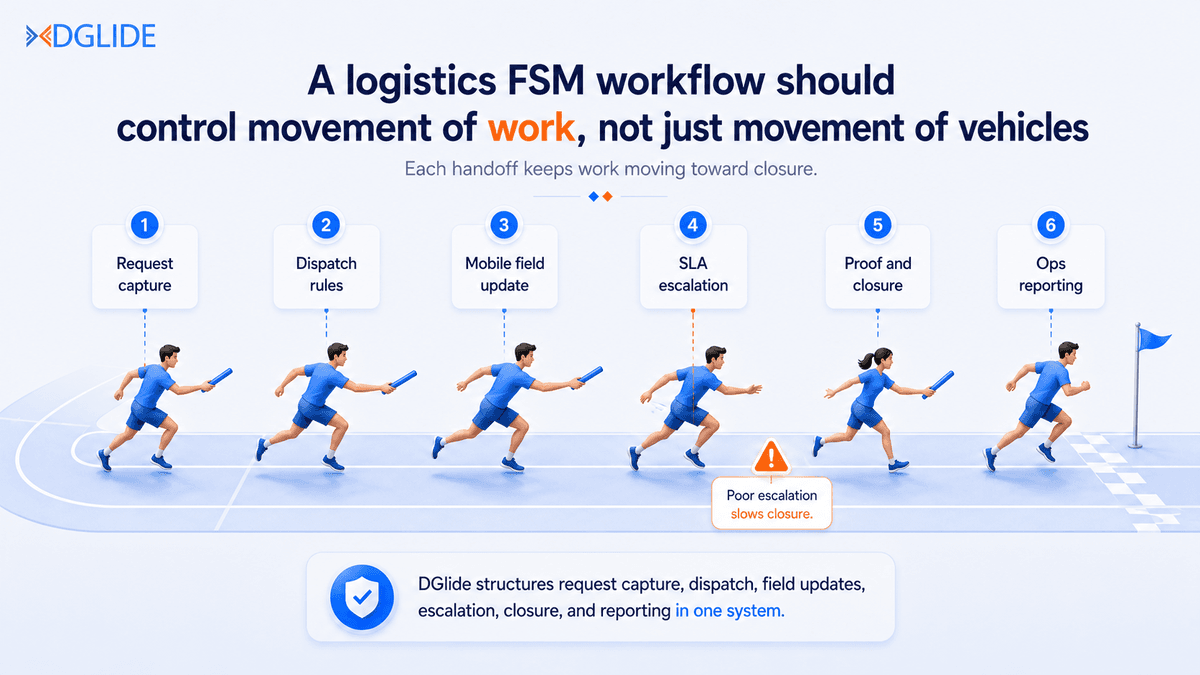
The Mistake Most FSM Shortlists Make
Most "best FSM software for India" shortlists rank tools by G2 stars and feature checklists, and skip the one problem that actually costs Indian logistics companies money: failed delivery from bad addresses, not bad routing.
A study found that, based on more than 180 million shoppers, found that India's average e-commerce return-to-origin rate sits at roughly 23 percent, rising to nearly 40 percent in some regions, with tier-3 cities accounting for the largest share of returns.
The problem: a route optimizer can plan the mathematically perfect route to an address that does not actually exist as written, and no amount of AI routing fixes that at the door.
The solution: evaluate FSM software on address verification, proof-of-delivery capture, and real-time dispatcher visibility specifically for tier-2 and tier-3 operations, not just metro performance numbers from a vendor's case study.
In field service deployments we have run for logistics and manufacturing operations, the tools that struggled were rarely the ones with weak routing math. They were the ones that assumed every address was reachable exactly as entered.
If your RTO problem looks like an address problem more than a routing problem, that changes what you should be evaluating. Talk to us for 15 minutes.
What Core Features Should Logistics FSM Software Have?
Logistics FSM software needs four core features to function in India specifically, and a platform missing any one of them will underperform regardless of its routing algorithm. Each solves a distinct operational problem.
AI-driven route optimization: Automated route optimization typically cuts drive time 15 to 30 percent and fuel consumption 10 to 25 percent compared to manually planned routes, though the gain depends heavily on stop density and territory shape.
Real-time GPS tracking; Lets a dispatcher see live location, not a last-synced position from an hour ago, which matters most exactly when a delivery window is slipping.
Mobile-first field access: A field agent working from a phone, often on inconsistent connectivity, needs offline capability and a simple interface, not a desktop-first tool shrunk onto a small screen.
Proof of delivery and dispatch automation: Captures signature, photo, or OTP confirmation at the point of delivery, and routes exceptions back to a dispatcher automatically instead of waiting for an end-of-day report.
None of these features matter in isolation. Route optimization without real-time tracking just means a plan nobody can verify is actually being followed.
Best FSM Software for Indian Logistics Companies Compared
The right FSM software depends on your operation's shape: high-volume enterprise dispatch, multi-carrier freight, or a mid-market logistics or manufacturing operation that also needs internal service and CRM workflows on the same platform.
What you need | Point tools | DGlide |
High-volume AI route optimization | Locus, Shipsy | Built in |
Multi-carrier, cross-border freight | Shipsy, FarEye | Not the core focus |
Technician scheduling and dispatch | FieldEZ, LogiNext Mile | Built in |
Retail and supply chain integration | 1Channel | Same platform |
Internal ITSM, CRM, and service desk | Not covered | Same platform |
No-code workflow configuration | Varies by vendor | Business user, no-code |
Read that way, the choice is not just which tool routes best, it is how much of your operation, field dispatch, internal service, and CRM, needs to live on one platform versus three.
Why Should You Choose DGlide?
If your logistics or field operations team is evaluating FSM software because dispatch, tracking, and internal service requests all run on separate tools, DGlide brings them together on one no-code platform.
GPS-enabled field tracking and AI-assisted task scheduling run alongside route optimization, not as a bolted-on module.
Mobile-first access is built for field agents working with inconsistent connectivity, not a shrunk desktop interface.
No-code configuration lets an operations manager adjust a dispatch rule directly, without a developer or a vendor ticket.
DGlide typically deploys in days to weeks, at roughly 40 percent lower cost than legacy platforms, with no specialist required. Pricing does not scale with every add-on.
vs Shipsy: DGlide combines field service, CRM, and internal ITSM on one platform; Shipsy focuses specifically on multi-carrier freight orchestration.
vs FieldEZ: DGlide's no-code workflow engine lets an ops manager reconfigure dispatch rules directly; many point tools route configuration changes through support.
DGlide fits mid-market logistics and manufacturing operations that want field service, CRM, and internal service management together, not enterprise freight networks needing deep multi-carrier orchestration at Shipsy or Locus's scale. Book a free 15-minute demo to see it on your own dispatch data.
Conclusion
The best FSM software for logistics companies in India is not the one with the highest G2 score or the longest feature list. It is the one that survives an actual Indian address, a tier-3 delivery window, and a COD return, not just a metro-market case study.
For an operations lead evaluating this now, the practical move is to test address handling and dispatcher visibility before comparing routing algorithms. Start by scoring your current shortlist against the five criteria above, not the vendor's own feature page.
FAQs
What is the best FSM software for logistics companies in India?
The best choice depends on your operation. Locus and Shipsy lead for high-volume, multi-carrier enterprise dispatch. For field service, CRM, and internal service management on one no-code platform, DGlide fits mid-market logistics teams.
Why do so many logistics deliveries fail in India specifically?
Failed deliveries are driven heavily by address issues, not just routing. India's average return-to-origin rate is around 23 percent, higher in tier-2 and tier-3 cities. Address verification matters as much as route optimization.
How much can route optimization actually save on fuel and drive time?
Automated route optimization typically cuts drive time by 15 to 30 percent. Fuel consumption savings usually range from 10 to 25 percent. Actual gains depend on stop density and territory shape.
Does DGlide replace dedicated freight platforms like Shipsy or Locus?
No, DGlide is not built for large-scale multi-carrier freight orchestration. It fits mid-market logistics and manufacturing teams needing field service, CRM, and internal ITSM together. Enterprise freight networks are better served by Shipsy or Locus specifically.