Work order management is the structured process of creating, assigning, tracking, and closing maintenance or service tasks from start to finish. It covers everything from a technician logging a broken HVAC unit to a facility supervisor closing that ticket and recording what parts were used. The term applies equally to industrial maintenance, facility operations, and IT service desks, even though most definitions online only describe the maintenance use case.
Facility directors and IT heads managing this process today are usually running it through a mix of tools that were never designed for it. A maintenance request submitted by email, tracked in a spreadsheet, and closed out verbally is still work order management, just an undocumented version of it.
A well-run preventive maintenance program built on this process can reduce overall maintenance costs by 12 to 18% compared to a reactive approach, according to the U.S. Department of Energy's Federal Energy Management Program. This blog defines the process, walks through its five stages, and covers where it typically breaks for teams without a dedicated system, including how DGlide's ticket management module handles it for facility and field operations.
TL; DR
Work order management is the same five-stage process whether it's running a factory floor or a building's helpdesk, which is why facility and IT teams should stop treating it as CMMS-only jargon. The process breaks down most often at the triage and assignment stages, not at request submission, since that's where undocumented tools lose accountability. Closure and analysis is the stage most teams skip entirely, which erases the audit trail a compliance review will eventually ask for. Preventive maintenance built on a documented process carries a real, DOE-verified cost advantage over reactive repair. A team evaluating a system for this process should test the assignment and closure stages first, not the request form.
What Is Work Order Management?
Work order management is the systematic process of turning a maintenance or service request into a tracked, assignable, and closeable task, from the moment it's reported to the moment it's documented as complete. A work order itself is the record: what was requested, who it was assigned to, what was done, and when it closed. That record is what separates work order management from simply telling a technician to “go fix it.”
The term originated in industrial maintenance, and IBM Maximo, MaintainX, and Accruent all define it primarily through that lens. But the same structure applies whenever a request needs to be logged, routed to the right person, and closed with a record, whether that's a broken air handler, a laptop that won't boot, or a lost badge at an airport terminal.
Work order management is not the same as a work request. A request is the initial ask; the work order is what the request becomes once it's been reviewed, prioritized, and assigned to someone accountable for closing it.
Why Do Most Definitions of Work Order Management Miss the Point?
Most published definitions of work order management describe it as a maintenance concept tied to CMMS software, and that framing hides where the process actually fails. The failure point isn't the definition. It's that facility teams, IT service desks, and field operations run this exact five-stage process every day without calling it that, usually through email threads and WhatsApp groups.
We've seen this directly in a ticket management deployment for a facility management operator, where the “system” before DGlide was a shared inbox that one person checked twice a day. The process was technically work order management. It just had no assignment logic, no SLA timer, and no record once a ticket was marked “done” verbally.
That gap between the textbook definition and how the process actually runs outside industrial plants is the real story most CMMS blogs skip. A facility supervisor or IT head doesn't need to understand ITIL terminology to benefit from documenting this process. They need a system that captures the same five stages without requiring a maintenance engineering background to set up.
If your team's version of work order management is a WhatsApp group and whoever checks it first, see how DGlide turns that into a tracked, assignable process in about an hour.
What Are the Stages of the Work Order Management Process?
Work order management runs through five sequential stages: request, triage and prioritization, assignment, execution, and closure and analysis. Each stage exists to answer one specific question, and skipping any of them is usually where the process quietly stops being “managed” and becomes ad hoc.
Request. A user, technician, or sensor submits a formal issue description and, ideally, a priority level, rather than a verbal or informal report.
Triage and prioritization. A supervisor or manager reviews the request, checks urgency against existing workload, and schedules the job accordingly.
Assignment. The task is routed to the technician or team with the right skill set and location, rather than to whoever happens to be free.
Execution. The assigned worker performs the task, logs time spent, and records any parts or materials used.
Closure and analysis. A supervisor verifies the work, formally closes the order, and the data feeds into performance and compliance reporting.
Most breakdowns in practice happen at triage and assignment, since that's where accountability either gets assigned to a specific person or gets lost in a shared inbox. Closure and analysis is the stage most informal systems skip entirely, even though it's the one a facility audit or SLA review will eventually need.
What Common Challenges Break Work Order Management in Practice?
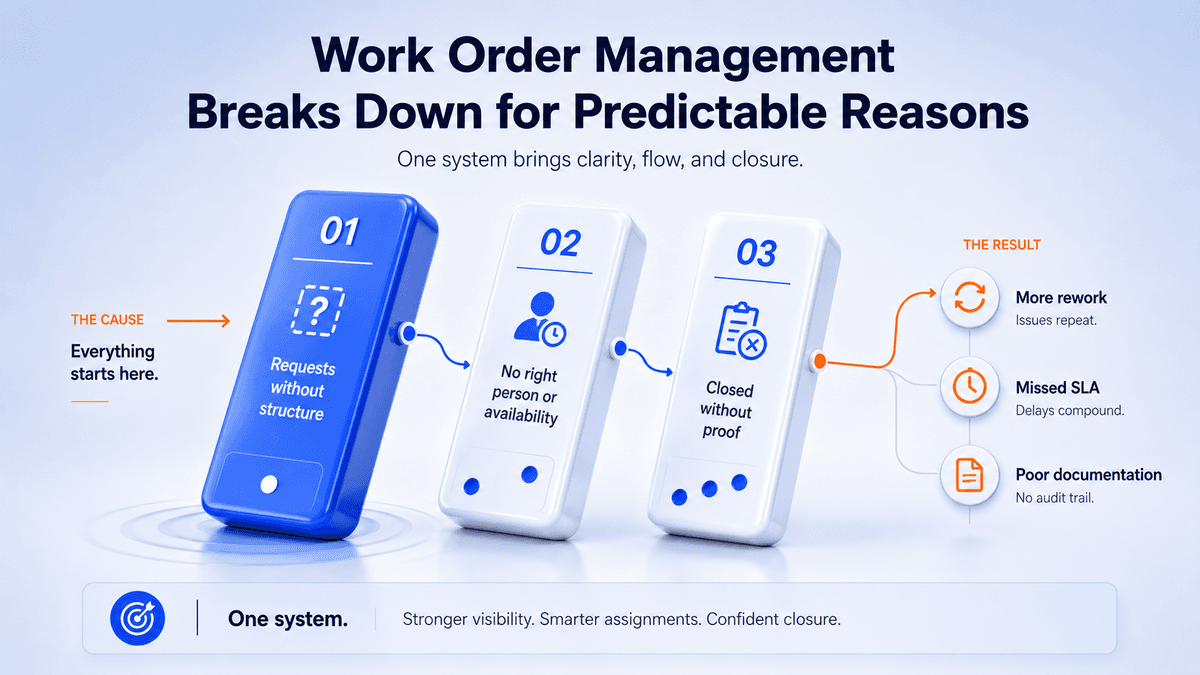
Work order management breaks down for predictable, repeatable reasons, most of which trace back to a missing system rather than a process design flaw. Three specific failure modes show up across facility, IT, and field operations teams.
No single system of record. When requests arrive by email, phone call, and WhatsApp simultaneously, nobody has a complete view of what's open, assigned, or overdue.
Assignment based on availability, not skill or location. Tasks routed to “whoever's free” instead of the right technician create rework and missed SLA windows.
Closure without documentation. A verbally “done” ticket leaves no record for compliance audits, warranty claims, or recurring-issue analysis.
Facility and IT teams that fix the system-of-record problem first tend to see the other two resolve on their own, since assignment and closure both depend on having one place all requests actually live.
What Has Changed for Work Order Management in 2026?
Work order management has shifted in 2026 toward AI-assisted triage and toward the process itself becoming visible directly in search results, rather than buried in vendor blog posts. Google's AI Overview now answers “what is work order management” with a structured, five-stage summary pulled from exactly the kind of content this blog provides.
That shift means facility and IT teams increasingly form their first impression of a work order system from an AI-generated answer, not a vendor's homepage. In parallel, 2026 systems are starting to auto-triage incoming requests by urgency and required skill set, compressing the triage stage from a manual review into a near-instant routing decision. A facility supervisor reviewing forty open tickets each morning benefits more from that automated triage than from any new dashboard.
The practical result: teams evaluating a work order system in 2026 should ask whether triage and assignment happen automatically, not just whether the tool can log a request.
What Does Good Work Order Management Look Like?
Good work order management looks like a single tracked process where every request has an owner, a status, and a closed record, regardless of whether it's a maintenance ticket or a facility helpdesk request. The table below contrasts what an undocumented process looks like against what a documented one delivers.
Undocumented Process | Documented Work Order Management |
Requests arrive by email, call, and chat with no single log | Every request enters one tracked queue |
Assignment is whoever answers first | Assignment is routed by skill and location |
“Done” is a verbal confirmation | Closure requires a logged record and verification |
No data for audits or recurring issues | Closure data feeds compliance and performance reporting |
A facility manager or IT head can use this table as a quick diagnostic: if more than one row on the left describes their current setup, the process is running without being managed. That gap is exactly what a dedicated system, rather than a better spreadsheet template, is built to close.
Why Should You Choose DGlide?
DGlide's ticket management and field service modules implement the same five-stage work order process this blog describes: request, triage, assignment, execution, and closure, built for facility operators, airports, and field service teams replacing email threads and WhatsApp groups. We've deployed this for a facility management operator and an airport client managing ticketing, asset monitoring, and lost-and-found workflows.
Automatic triage and routing by skill set and location, so requests stop landing with “whoever's free.”
SLA timers on every stage, so a facilities ticket or IT request has a visible deadline, not a verbal promise.
Closure with mandatory documentation, so every completed work order leaves an audit-ready record.
Configurable workflows a facility supervisor sets up without a developer, since the five stages look different for a ticketing desk than a maintenance shop.
Mobile execution and closure, so a technician logs time and parts from a phone at the job site.
DGlide deploys in days to weeks, not the months typical of enterprise EAM rollouts, and facility teams report roughly 40% lower IT cost compared to legacy vendor contracts.
If your organization runs thousands of industrial assets and needs deep asset-lifecycle and predictive-maintenance depth, a dedicated EAM platform like IBM Maximo may genuinely serve that scope better than DGlide today. For facility, ticketing, and field service operations that need the five-stage process running without a maintenance engineering setup, book a 15-minute demo.
Conclusion
Work order management is the same five-stage process, request, triage, assignment, execution, and closure, whether it's running a factory floor or a building's helpdesk. Most teams already run this process informally through email and chat; the gap isn't the concept, it's the missing system of record that makes triage, assignment, and closure actually accountable.
For a facility manager or IT head evaluating whether to formalize this process, the test isn't whether a tool can log a request. It's whether triage routes automatically and closure leaves a documented record that survives an audit.
FAQs
What is a work order in work order management?
A work order is a structured record of a maintenance or service request, including what was needed, who was assigned, and what was done. It becomes the system of record once a request is reviewed and approved. Work order management is the process of creating, tracking, and closing these records.
What is the difference between a work order and a work request?
A work request is the initial ask submitted by a user or technician. A work order is what that request becomes once triaged, prioritized, and assigned to someone accountable for completing it. The distinction matters because only work orders carry SLA timers and closure documentation.
What are the main types of work orders?
The main types are preventive, corrective, and reactive work orders. Preventive work orders follow a set maintenance schedule to avoid failures. Corrective and reactive work orders address faults or failures after they've already occurred.
What software is used for work order management?
Work order management software ranges from industrial CMMS platforms to no-code ticketing systems like DGlide. The right choice depends on whether the team needs deep industrial asset-lifecycle tracking or fast, configurable ticketing for facility and field operations. Most platforms cover the same five-stage process with different depth and setup complexity.