Field service management software reduces first-time fix failures, cuts administrative overhead, and gives managers live visibility into where every technician is and what job they're on. A Forrester Total Economic Impact study found that a composite organization generated 195% ROI over three years by adopting field service management software, but that figure sits inside a published range running from roughly 100% to 400% depending on the vendor and study. That spread is the part most benefits articles skip.
Operations leaders evaluating field service software today are usually comparing headline ROI percentages without knowing why they differ so much between vendors. A VP Operations or field service manager at a manufacturing or FMCG company typically has a team running on paper job sheets, phone calls, and a supervisor's memory of who's available.
The global field service management market reached USD 6.14 billion in 2026 and is growing at a 10.70% CAGR, according to Fortune Business Insights. This blog covers the verified benefits, why ROI figures vary so widely, and the best practices that determine whether a team actually captures them, including how DGlide's field service module supports this for manufacturing and facility field teams.
TL; DR
The benefits most FSM articles list, scheduling, visibility, first-time fix rate, are real but conditional on data discipline that exists before the software arrives. Published ROI figures range from roughly 100% to 400% across studies, and that range tracks implementation quality, not platform choice. First-time fix rate is the single metric most tied to ROI, since each missed fix triggers a full second truck roll with its own labor and fuel cost. Best practices around dispatch logic and mobile data capture matter more than any dashboard feature a vendor demos. A team without in-house IT should test dispatch automation directly, not just review a feature list.
What Are the Real Benefits of Field Service Management Software?
Field service management software delivers six consistently verified benefits: smarter scheduling and dispatching, real-time technician visibility, higher first-time fix rates, better customer communication, faster invoicing, and lower operating costs. Each benefit compounds on the others rather than acting independently, which is why isolated feature comparisons undersell what the software actually changes.
Smart scheduling and dispatching. Jobs route to technicians based on skill set, location, and availability instead of whoever a dispatcher remembers is free that morning.
Real-time visibility. GPS tracking and live dashboards let a manager see technician location and job progress without a phone call.
Higher first-time fix rates. Technicians arrive with equipment history and parts inventory already loaded, cutting the return-visit rate that drives most field service cost.
Better customer experience. Automated arrival windows and live tracking links replace the “he'll call when he's on his way” approach.
Faster invoicing. Digital work orders let a technician close a job and trigger an invoice on-site instead of a paper form reaching accounting a week later.
Lower operating costs. Optimized routing and reduced admin overhead cut fuel spend and overtime hours directly.
These six benefits are the same list Google's AI Overview surfaces for this query, and for good reason: they're consistently verified across FSM vendors and independent studies. What differs is how much of each benefit a specific team actually captures.
Why Do FSM ROI Claims Swing From 100% to 400%?
FSM ROI claims vary so widely because published studies measure different starting points, not because some platforms are dramatically better than others. A team with disciplined scheduling and clean asset data before rollout captures far more of the software's potential than a team migrating from paper job sheets with no historical data at all.
We've seen this directly in a field team coordination deployment for a manufacturing client, where the biggest ROI driver wasn't the dispatch algorithm. It was that technicians finally logged parts used and job notes consistently, because the mobile app made it faster than the paper form they'd been ignoring.
That gap between a vendor's headline ROI percentage and what a specific team will actually see is the piece most benefits articles leave out. A field service manager comparing a “195% ROI” claim against a “400% ROI” claim is usually comparing two different starting points, not two different software quality levels.
If your technicians are still filling out paper job sheets that a supervisor re-enters into a spreadsheet at the end of the week, see how DGlide's field service module captures that data on-site instead.
What Do Verified FSM ROI Numbers Actually Show?
Verified FSM ROI data shows first-time fix rate as the single metric most directly tied to financial return, with certified technicians improving from roughly 70% to 95% in a Forrester-measured deployment. That eighteen-to-twenty-five point swing eliminates a large share of the second truck rolls that drive field service cost.
A Forrester Total Economic Impact study found a composite organization generated 195% ROI over three years, with $13.2 million in benefits against $4.5 million in costs, commissioned research reported through Salesforce. The same study recorded no-show rates dropping from 10 to 15% down to roughly 3% once automated reminders and simplified rescheduling were in place.
Each prevented repeat visit in that study saved between $100 and $200 in direct cost, separate from the customer relationship damage a missed fix causes. A field service manager modeling ROI internally should treat first-time fix rate and no-show rate as the two numbers worth tracking before and after rollout, since they're the ones with the clearest financial trail.
What Are the Best Practices for Capturing These Benefits?
The best practices that determine whether a team captures FSM's benefits center on dispatch discipline, mobile data capture, and treating the rollout as a process change, not a software swap. Four practices show up consistently across teams that see the higher end of the ROI range.
Fix dispatch logic before go-live. Define skill-and-location routing rules in advance, rather than letting the software's default settings decide who gets which job.
Make mobile data capture mandatory, not optional. First-time fix improvements depend on technicians actually logging parts and notes on-site, not on the feature existing.
Automate customer reminders from day one. No-show reduction is one of the fastest-realized benefits and requires no process change beyond turning the feature on.
Review first-time fix rate monthly, not annually. Teams that catch a drop early can retrain or reassign before it compounds into a larger cost problem.
A field service manager without a dedicated analyst can track just these four practices and see most of the benefit curve competitor articles describe as automatic.
What Has Changed for Field Service Management Benefits in 2026?
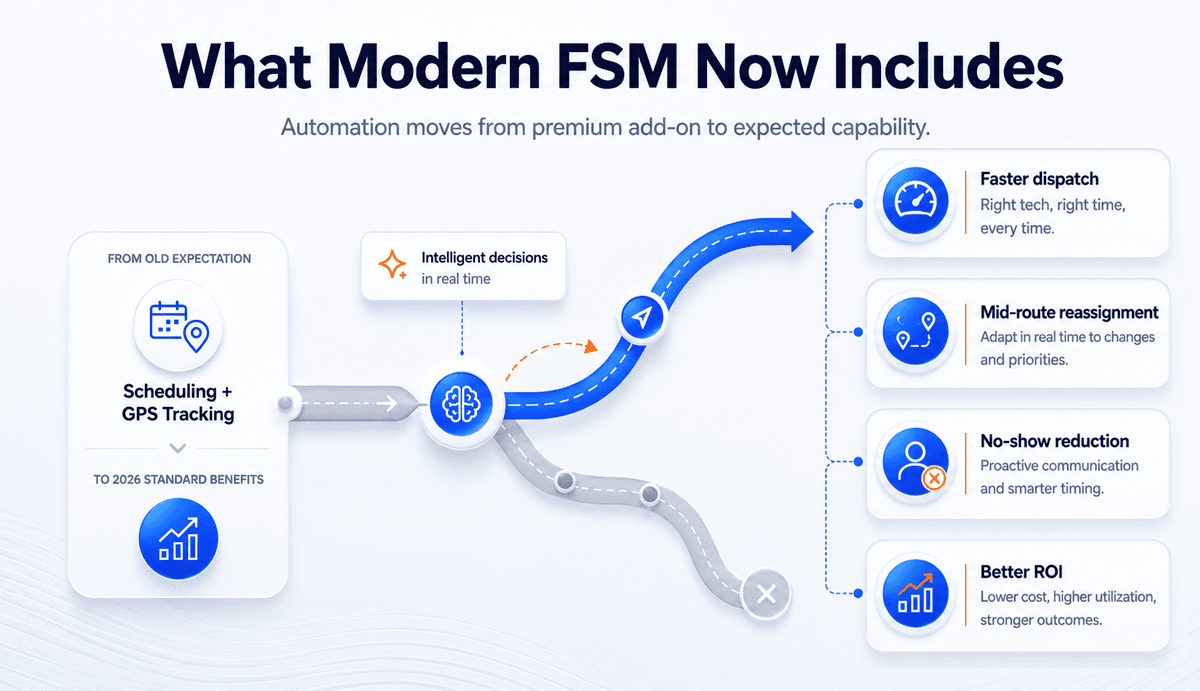
Field service management benefits have expanded in 2026 to include AI-assisted auto-dispatch and automated no-show reduction as standard features, not premium add-ons. Two years ago, most of the benefit list started and ended with scheduling and GPS tracking.
In 2026, dispatch systems increasingly reassign a technician mid-route when a higher-priority job comes in, without a dispatcher manually rebalancing the day. Automated reminder sequences, the same mechanism behind the Forrester study's no-show reduction, are now a default configuration rather than a paid upgrade. A manufacturing or facility team evaluating FSM software this year should expect auto-dispatch and no-show automation included, not sold separately.
That shift means the benefits list itself has grown, even as the core four, scheduling, visibility, first-time fix, and cost, remain the ones with the clearest financial trail back to ROI.
When a technician gets reassigned mid-route because a higher-priority job came in, and nobody has to call three people to make that happen, that's the 2026 version of FSM benefits. DGlide built this for a manufacturing client's field team in under a month.
What Do Teams Get Wrong When Chasing These Benefits?
Teams most often fail to capture FSM's benefits by treating the software as a scheduling upgrade rather than a data discipline change, and the gap between the two shows up clearly in practice. The table below contrasts what separates teams that capture the ROI range from teams that don't.
Teams That Miss the Benefits | Teams That Capture Them |
Dispatch defaults left unconfigured at go-live | Skill-and-location routing rules defined before launch |
Mobile data capture treated as optional | Technicians required to log parts and notes on-site |
Automated reminders never turned on | Reminder sequences active from day one |
First-time fix rate reviewed annually, if at all | First-time fix rate reviewed monthly |
A team that recognizes more than one row on the left as their current plan is likely to land closer to the low end of the published ROI range, regardless of which platform they choose. Fixing the process gaps before rollout matters more than any single feature comparison.
Why Should You Choose DGlide?
DGlide's field service module was built around the same four practices that determine whether a team captures FSM's benefits: dispatch discipline, mandatory mobile data capture, automated reminders, and visible first-time fix reporting. We've deployed this for a manufacturing client coordinating field teams that previously ran on phone calls and a shared spreadsheet.
Skill-and-location dispatch rules configured by an operations manager, not left on vendor defaults.
Mandatory mobile job closure so parts, notes, and photos are captured on-site, not reconstructed later.
Automated customer reminders included from day one, not sold as an add-on.
First-time fix and no-show dashboards an operations manager reviews monthly without pulling a report from IT.
GPS-based mid-route reassignment for higher-priority jobs, without a dispatcher calling three technicians.
DGlide deploys in days to weeks, not the months typical of enterprise field service rollouts, and facility and manufacturing teams report roughly 40% lower IT cost compared to legacy vendor contracts.
If your organization runs a fleet of thousands of technicians and needs deep IoT-based predictive maintenance triggers across global regions, an enterprise platform like Salesforce or ServiceNow may genuinely serve that scale better than DGlide today. For a manufacturing or facility field team that needs dispatch discipline and mobile data capture running without a consultant, book a free 15-minute demo.
Conclusion
Field service management software delivers real, verified benefits: better scheduling, live visibility, higher first-time fix rates, and lower operating costs. But the ROI figure a team actually sees depends far more on dispatch discipline and mobile data capture than on which platform's demo looked the most polished.
For a VP Operations or field service manager building the case before a vendor search, the useful benchmark isn't a vendor's headline ROI percentage. It's whether the team can commit to the four best practices this blog covers, since those determine which end of the published range a rollout lands on.
FAQs
What are the main benefits of field service management software?
The main benefits are smarter scheduling, real-time technician visibility, higher first-time fix rates, better customer communication, faster invoicing, and lower operating costs. These six benefits are consistently verified across independent studies and vendor platforms. First-time fix rate carries the clearest financial link to ROI.
How is field service management ROI actually measured?
Field service management ROI is measured by comparing benefits like reduced truck rolls and lower no-show rates against software and implementation costs. A Forrester study found 195% ROI over three years for one composite organization. The exact figure varies based on process discipline before rollout.
What is a good first-time fix rate for field service teams?
A good first-time fix rate is generally 85% or higher, up from an industry average closer to 70 to 75%. Field service software raises this by giving technicians equipment history and parts data before they arrive. Each missed fix typically triggers a full second visit with its own cost.
Does field service management software work for small field teams?
Field service management software works for small field teams as long as the platform doesn't require a dedicated administrator to configure. No-code platforms let a small team's operations lead set dispatch rules and reminders without an IT specialist. Larger enterprise platforms often assume a team size that small operations don't have.