
Quick Answer: An AMC, or annual maintenance contract, is a fixed-fee agreement where a provider maintains, inspects, and repairs specific equipment, IT hardware, or facilities over a set period, usually a year, replacing unplanned repair calls with a scheduled, budgeted relationship. |
Most guides to AMCs stop at explaining comprehensive versus non-comprehensive coverage and call it done. That leaves out the part that actually determines whether an AMC delivers value: whether the commitments inside it, response time, parts pricing, scheduling, are specific enough to hold a provider to, or vague enough that nobody ever checks.
What's the actual difference between a comprehensive and non-comprehensive AMC?
Does an AMC cover the same things a warranty does?
What should be in the contract before you sign it, not after something breaks?
Siemens' True Cost of Downtime 2024 report found that the world's 500 biggest companies lose roughly $1.4 trillion annually to unplanned downtime, equivalent to 11 percent of their total revenue. An AMC exists specifically to move that cost from unplanned to scheduled. This piece covers how to evaluate AMC options, the types available, what a strong contract includes, and what most guides skip.
TL;DR
An AMC is a fixed-fee agreement for scheduled maintenance, inspection, and repair over a set period, usually one year.
Comprehensive AMCs include spare parts and labor. Non-comprehensive AMCs cover labor only, with parts billed separately.
An AMC is not the same as a warranty, a warranty is manufacturer-backed and time-limited, an AMC is a paid service relationship you choose to renew.
The biggest gap in most AMCs is vague response-time language that nobody actually tracks once the contract is signed.
Manufacturing, aviation, facility management, and IT-heavy operations rely on AMCs most, since equipment downtime there carries the highest cost.
What Is an AMC (Annual Maintenance Contract)?
An AMC is a formal agreement between a business and a service provider covering the ongoing repair, routine servicing, and upkeep of equipment, IT hardware, or facilities over a fixed period, usually one year. The provider commits to scheduled visits and defined response times, in exchange for a predictable annual fee.
The contract exists to replace reactive, pay-per-incident repair with a planned relationship. Instead of calling a vendor after something fails, the maintenance schedule and the response commitment are already agreed to in advance.
Types of AMC Contracts
Most AMCs fall into one of two structures, and the difference changes both the price and what happens when a part actually fails.
Comprehensive AMC. Covers regular service, labor, emergency calls, and the cost of replacement spare parts. Higher upfront price, no surprise repair invoices.
Non-comprehensive AMC. Covers routine check-ups and repair labor only. Spare parts get billed separately, as needed.
A comprehensive AMC costs more per year but removes budget uncertainty entirely. A non-comprehensive AMC costs less upfront but shifts part-replacement risk back onto the client.
How We Evaluated AMC Contract Options
Comparing AMC structures on price alone misses most of what actually determines whether an agreement holds up once equipment starts aging. Five criteria matter more than the sticker price.
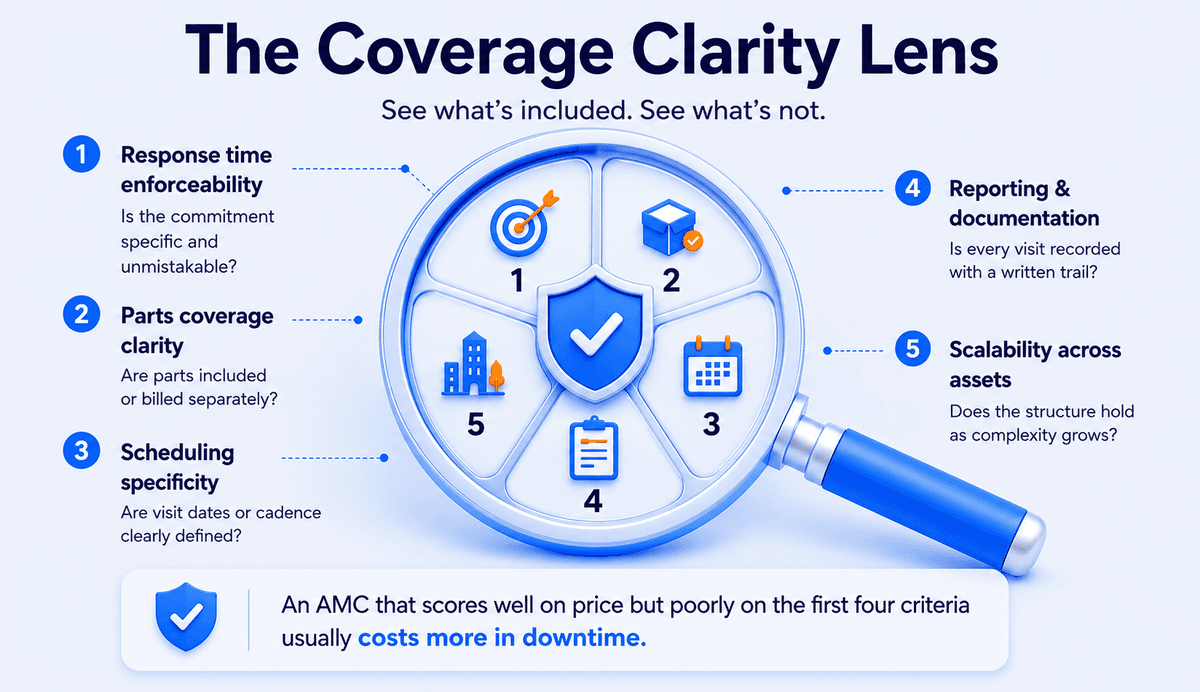
Response time enforceability: Is the commitment a specific number, four hours, next business day, or a phrase like "prompt service" that nobody can hold the provider to once a dispute starts?
Parts coverage clarity: Are spare parts included in the fee, or billed separately at a rate that's locked in for the contract term versus one that floats with the provider's current pricing?
Scheduling specificity: Does the contract list actual visit dates or a fixed cadence, monthly, quarterly, or does it just say "regular maintenance" without a calendar anyone can check against?
Reporting and documentation: Does every visit produce a written record, what was inspected, what was found, what was done, building a service history, or does nothing get written down beyond a technician's signature?
Scalability across assets: Does the structure still work cleanly when it covers five assets across two sites, or does it only make sense for a single piece of equipment?
An AMC that scores well on price but poorly on the first four criteria usually costs more in downtime than it saves in fees, and that gap rarely shows up until the first time something actually breaks mid-contract.
How Should Businesses Choose Between AMC Types?
The right AMC type depends on how much budget certainty is worth paying for upfront, not on which option looks cheaper on the cover page.
A business with tight, predictable maintenance budgets and low tolerance for surprise invoices should lean comprehensive, even at a higher annual fee, because the entire point is removing financial uncertainty. That matters most for equipment where a single part failure carries a disproportionate cost, specialized components, long lead times, or parts that are hard to source on short notice.
A business with lower-risk equipment, or an internal team that can absorb occasional part costs without disrupting the budget, can reasonably choose non-comprehensive and pocket the savings most years. That works fine right up until the equipment starts aging past its reliable years, which is exactly when the savings disappear.
The mistake is picking based on last year's spend instead of this year's risk. Equipment nearing the end of its expected lifespan is exactly when non-comprehensive coverage gets expensive fast, since older equipment fails more often and needs more parts, and a contract signed three years ago rarely gets revisited to reflect that shift. The right move is reviewing the type annually, not treating the original choice as permanent.
Not sure whether your equipment profile fits comprehensive or non-comprehensive coverage? Talk to us for 15 minutes and we'll help you work through it.
The Mistake Most AMC Guides Make
Most content about AMCs treats the comprehensive-versus-non-comprehensive decision as the entire question, and stops there. That's half the picture.
The problem: two contracts can carry the identical "comprehensive" label and deliver completely different outcomes, because the label says nothing about whether response times are enforceable, whether reporting actually happens, or whether the provider tracks its own performance against the contract at all.
The solution: evaluate the specific language inside the contract, not just which of the two categories it falls into. A non-comprehensive AMC with a hard four-hour response commitment and documented visit reports can outperform a comprehensive AMC with vague "prompt service" language and no reporting at all.
This is where most AMC comparisons fall short. A guide that only explains "comprehensive covers parts, non-comprehensive doesn't" is technically accurate and still leaves the reader unable to actually evaluate a contract sitting in front of them. The category tells you what's covered. It says nothing about whether the coverage is enforceable.
The type of AMC is a starting filter. The actual contract language, the specific numbers, the specific dates, the specific escalation path when something is missed, is what determines whether it works once the relationship is a year in and something has actually gone wrong.
What Should Be Included in an AMC?
A well-structured AMC bundles together a specific set of commitments, not just a promise to show up when something breaks.
Scheduled preventive visits. Routine inspection, cleaning, and calibration on a fixed calendar, not triggered by a complaint, catching wear before it becomes a failure.
Defined response times. A specific commitment for how quickly a technician responds after an issue is reported, ideally tiered by severity rather than a single blanket number.
Labor coverage. Technician time for both scheduled visits and unscheduled repair calls, spelled out clearly enough that there's no ambiguity about what a service fee already covers.
Parts coverage or pricing. Either included in the fee, comprehensive, or billed separately at a pre-agreed rate, non-comprehensive, with that rate locked for the contract term rather than left open.
Reporting. Documentation of every visit, what was found, what was done, and what to watch going forward, building a service history over time instead of starting from zero at every visit.
Renewal terms. What happens at the end of the period, automatic renewal, a required notice window, or renegotiation, spelled out before the first year even starts.
A contract missing defined response times is the most common gap, since it leaves the one commitment clients actually care about unmeasured, and unmeasured commitments are the ones that quietly stop being honored.
AMC vs. Warranty vs. On-Call Repair
These three get confused constantly, and the difference matters for budgeting and for what happens when equipment fails.
A warranty is manufacturer-backed, free, and time-limited, typically covering defects in materials or workmanship rather than routine wear and tear. It protects against something being wrong with the equipment from the start, not against the equipment aging normally under use. An AMC is a paid, renewable service relationship covering scheduled maintenance and repair, chosen and renewed by the client for as long as it makes sense to keep paying for it.
On-call repair carries no ongoing relationship at all, a technician gets called and paid per incident, with no scheduled maintenance included and no guaranteed response time beyond whatever the vendor happens to offer that day. It's the cheapest option in a given month and the most expensive option over a year of unplanned downtime.
An AMC typically starts once the warranty period ends, picking up the maintenance responsibility a manufacturer no longer covers for free. The gap between the two is where a lot of equipment quietly goes unmaintained, the warranty has expired, the business hasn't signed an AMC yet, and nothing is scheduled until something breaks.
Key Benefits of an AMC
An AMC pays off in ways that go beyond simply having someone to call when something breaks.
Cost predictability. A fixed annual fee replaces unpredictable emergency repair bills with a number that fits into next year's budget.
Extended asset life. Regular tune-ups, cleaning, and calibration catch wear before it becomes a failure, reducing wear and tear on high-value machinery.
Guaranteed response. A defined response time means minimal downtime waiting to find and negotiate with a vendor after something has already failed.
AMC Types and Structures Compared
Structure | Parts Coverage | Response Time | Best Suited For |
Comprehensive AMC | Included in fee | Defined in contract | Businesses wanting zero budget surprises |
Non-comprehensive AMC | Billed separately | Defined in contract | Lower-risk equipment, newer assets |
Warranty | Manufacturer-covered | Manufacturer's terms | New equipment still under original coverage |
On-call repair | Billed per incident | Not guaranteed | Low-value, rarely-used equipment |
Most operations running more than a handful of critical assets end up using a mix, warranty while it lasts, then AMC coverage that shifts from comprehensive to non-comprehensive as equipment ages and risk profiles change. Newer, higher-value equipment tends to sit under comprehensive coverage while the failure cost is highest, and shifts toward non-comprehensive once the business has enough service history, tracked on a no-code platform rather than memory, to know how often it actually needs parts.
Who Needs an AMC?
AMCs matter most wherever equipment downtime carries a real operational or financial cost, not just a minor inconvenience.
Manufacturing. Production line equipment where downtime stops output directly, and every hour offline carries a measurable cost against a production target.
Aviation. Ground equipment and facility systems where reliability is a safety requirement, not just a convenience, and failure isn't an option that gets absorbed quietly.
Facility management. HVAC, elevators, and building systems across multiple sites or tenants, where one missed maintenance window can affect dozens of people at once.
Logistics and warehousing. Conveyor systems, loading equipment, and refrigeration units where a single failure can back up an entire operation behind it.
IT-heavy operations. Servers, networking hardware, and infrastructure where an outage affects every department at once, not just the team that owns the equipment.
A business with one or two low-value assets rarely needs an AMC, the cost of the contract can outweigh the cost of occasional repair. A business running equipment that would be expensive, disruptive, or dangerous to lose usually does, and the calculation gets clearer the more assets are involved.
Running AMCs across multiple sites or vendors already? See what tracking all of them on one system actually looks like.
Why Should You Choose DGlide?
DGlide's AMC management capability ties contract renewal dates, response-time commitments, and service history to the same platform running field service and ticketing, so a contract isn't tracked separately from the work it governs.
Renewal dates and response-time targets stay attached to the asset record, not a spreadsheet someone has to remember to check.
No-code configuration lets an operations manager set escalation rules when a response time is at risk of breaching, before it turns into a missed commitment.
Every scheduled and unscheduled visit logs against the same asset history technicians already use in the field, so the service record building up matches what actually happened, not what a provider reported after the fact.
Renewal windows surface automatically, instead of relying on someone remembering a date buried in a signed PDF from a year ago.
DGlide fits mid-market operations managing AMCs across multiple sites, vendors, or asset types, where a spreadsheet stops being enough and the tracking gap starts costing more than the contracts themselves, at pricing scoped to the platform rather than per contract. Book a free 15-minute demo to see it against your own contract portfolio.
Conclusion
An AMC only delivers on its promise of predictability when the contract itself is specific, a real response time, clear parts coverage, and a defined maintenance schedule, not vague language nobody enforces. The type that fits, comprehensive or non-comprehensive, depends on how much budget certainty is worth paying for upfront, and that answer changes as equipment ages, which means the original choice deserves a second look every renewal, not a rubber stamp.
The businesses that get the most value from an AMC are the ones tracking it actively once signed, not filing it away until something breaks. That tracking gap, not the contract terms themselves, is where most AMC value quietly gets lost, and it's the same gap most AMC guides skip entirely, since it's easier to explain two categories than to explain how to hold a provider to what's written inside either one.
Before renewing an existing AMC or signing a new one, pull the actual document and check it against the five evaluation criteria above. A contract that fails on response-time specificity or reporting is worth renegotiating before the next signature, not after the next outage.
FAQs
What is an AMC (annual maintenance contract)?
It is a fixed-fee agreement where a provider maintains, inspects, and repairs equipment or facilities over a set period, usually a year. It replaces ad hoc repair calls with a scheduled relationship.
What is the difference between a comprehensive and non-comprehensive AMC?
A comprehensive AMC includes spare parts and labor in the fee. A non-comprehensive AMC covers labor only, with parts billed separately as needed.
Is an AMC the same as a warranty?
No, a warranty is free and manufacturer-backed with a fixed expiry. An AMC is a paid, renewable service relationship a business chooses to enter and renew.
What should I check before signing an AMC?
Confirm the response time is a specific number, check whether parts are included or billed separately, and make sure the maintenance schedule has actual dates, not vague language.