
The Hidden Reason Your Deals Collapse After Day 2
Most deals that go cold do not die on the first call, they die on the second one that never happens. A prospect who sounded ready on day one goes quiet by day three, and the usual explanation, they lost interest, is almost never the real one. The real reason is a scattered follow-up system that quietly drops the ball.
For a sales lead running a small team, that gap is expensive precisely because it is invisible. Nobody logs a "missed follow-up" in a pipeline report. The deal just stops showing up as active, and it looks identical to a prospect who genuinely walked away.
A research found that roughly 80 percent of non-routine sales require at least five follow-ups, while 44 percent of salespeople give up after just one. This piece looks at why that gap opens on day two specifically, and where DGlide's CRM fits in closing it.
TL;DR
Deals rarely collapse from lead disinterest, they collapse from a follow-up that never got logged anywhere.
The classic advice to "just follow up more" misses that the problem is usually the system, not the rep's discipline.
Response speed compounds the damage: contacting a lead within 5 minutes still beats 30 minutes by a wide margin.
Centralizing reminders into one system is a smaller fix than it sounds, and a bigger one than most teams admit they need.
DGlide's CRM keeps every follow-up, reminder, and next step in one view, not split across a notebook, an inbox, and memory.
What's Really Behind Deals That Go Cold After Day 2?
Deals go cold after day two because the follow-up depends on a rep remembering it, not a system tracking it. The moment a call ends, that reminder lives in a notebook, a sticky note, or a mental note competing with five other open deals. By day three, something else has taken priority, and the lead has not heard back.
The reminder never had a home: Without one system tracking next steps, a follow-up exists only in a rep's memory until it does not.
Distractions outrank a soft deadline: A new meeting or an inbound call beats a "remember to call them back" every time.
The lead does not wait: A prospect who does not hear back inside a few days assumes the vendor is not serious, and starts taking other calls.
None of this means the rep did not care about the deal. It means the system asked them to hold an entire pipeline in their head, and pipelines do not stay in anyone's head past a few open deals.
Still tracking follow-ups across a notebook, a phone reminder, and a spreadsheet? See what one unified follow-up view looks like in 15 minutes.
Why "Just Follow Up More" Misses the Real Problem
Telling a sales team to follow up more assumes the problem is effort, when the actual problem is almost always fragmentation across tools. A rep who wants to follow up consistently still has to remember which of four places, a calendar, a phone, a CRM tab, a sticky note, holds the reminder for this specific lead.
The problem: every scattered reminder system asks a rep to be their own project manager on top of selling, and that job gets dropped the moment the pipeline gets busy.
The solution: one system that owns every reminder and next step removes the memory burden, so persistence stops depending on how good a rep's memory is that week.
Speed compounds this. The original MIT Sloan and InsideSales.com lead response study, often misattributed to Harvard Business Review in later retellings, found that contacting a lead within 5 minutes made it 100 times more likely to connect and 21 times more likely to qualify than waiting 30 minutes. A system that lets a follow-up sit for three days is losing on both fronts at once.
If your best rep's follow-up discipline depends on how busy their week is, that is not a discipline problem. Talk to us for 15 minutes about a system that does not forget.
The Hidden Cost of Scattered Reminders
The hidden cost of scattered reminders is not one obviously lost deal, it is a slow leak across every deal in the pipeline that never shows up as a single line item. A missed follow-up does not get logged as a loss, the deal just quietly stops moving. The 114 B2B companies found nearly 1 in 5 never responded to a new lead by email at all, not slowly, just never.
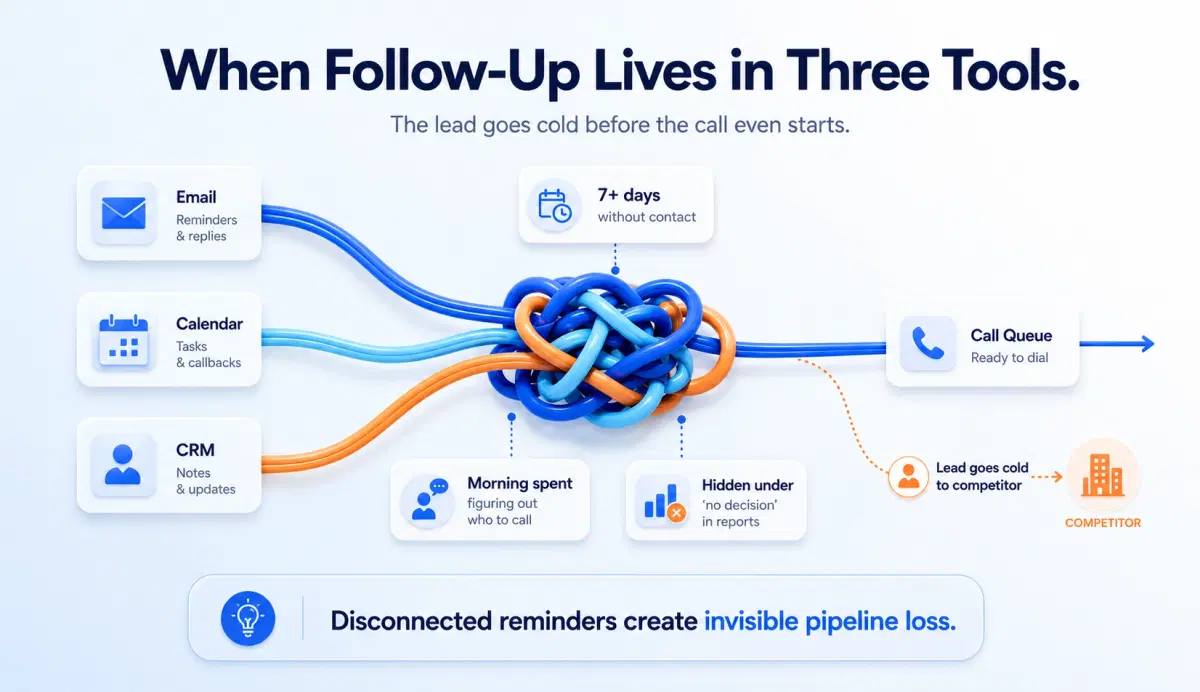
Leads that go seven or more days without contact are the ones competitors reach first.
A rep juggling reminders across three tools spends real time each morning just figuring out who to call, before making a single call.
None of this shows up in a pipeline report as "lost to poor follow-up," it shows up as "lost to no decision," which hides the actual cause.
That last point is why the problem persists. If the cost were visible on a dashboard, it would already be fixed.
What Does an Actual Fix for This Look Like?
A real fix centralizes every reminder, task, and next step into one view a rep checks once, instead of reconstructing from memory every morning. The goal is not more effort, it is removing the places a follow-up can silently disappear.
Put every open follow-up in one place. If a next step lives in a notebook or a second app, it is one distraction away from being missed.
Make the next action visible without a search. A rep should see today's follow-ups the moment they open the system, not dig for them.
Track the pattern, not just the task. A system that shows which leads have gone quiet for days surfaces the risk before the deal is actually gone.
One honest note: centralizing reminders will not save a deal that was never a real fit. It only fixes the deals lost to process, which, per the numbers above, is most of them.
Why Should You Choose DGlide?
If your team's follow-ups live across a notebook, a phone reminder, and a CRM tab that nobody checks daily, DGlide replaces that with one place, one view, and zero missed opportunities.
Every reminder and task sits in a single unified view, not split across apps.
A rep opens one screen to see exactly which leads need a follow-up today, not a search across three tools.
Pipeline stages update alongside the reminder, so a stalled deal is visible before it goes cold.
DGlide deploys in days to weeks, with no specialist required to set up a follow-up workflow. Book a live DGlide walkthrough and see your own pipeline in one view.
Conclusion
Deals rarely collapse because a lead stopped caring. They collapse because a follow-up lived somewhere a rep could forget it, and by the time anyone noticed, the deal had already gone quiet.
For a sales lead who acts on this, the fix is not a pep talk about persistence. It is removing the places a reminder can disappear, so the next follow-up happens because the system caught it, not because a rep happened to remember.
FAQs
Why do sales deals go cold right after the first conversation?
Sales deals go cold after the first conversation mainly due to missed follow-up, not lost interest. A reminder that lives only in a rep's memory is easy to drop. By the time it is remembered, the lead has often moved on.
How many follow-ups does a typical deal actually need?
Most non-routine deals need five or more follow-ups to close. Roughly 44 percent of salespeople stop after just one attempt. That gap is where most deals are lost.
Does responding faster to a lead actually make a measurable difference?
Yes, responding within 5 minutes instead of 30 makes a lead far more likely to be reached and qualified. The original study found gains of 100 times and 21 times respectively. Fast, consistent follow-up compounds over the length of a deal.
How does DGlide help prevent deals from going cold?
DGlide centralizes every reminder, task, and next step into one view. A rep sees today's follow-ups without checking multiple tools. Persistence stops depending on memory, so fewer deals go cold from a missed call.