

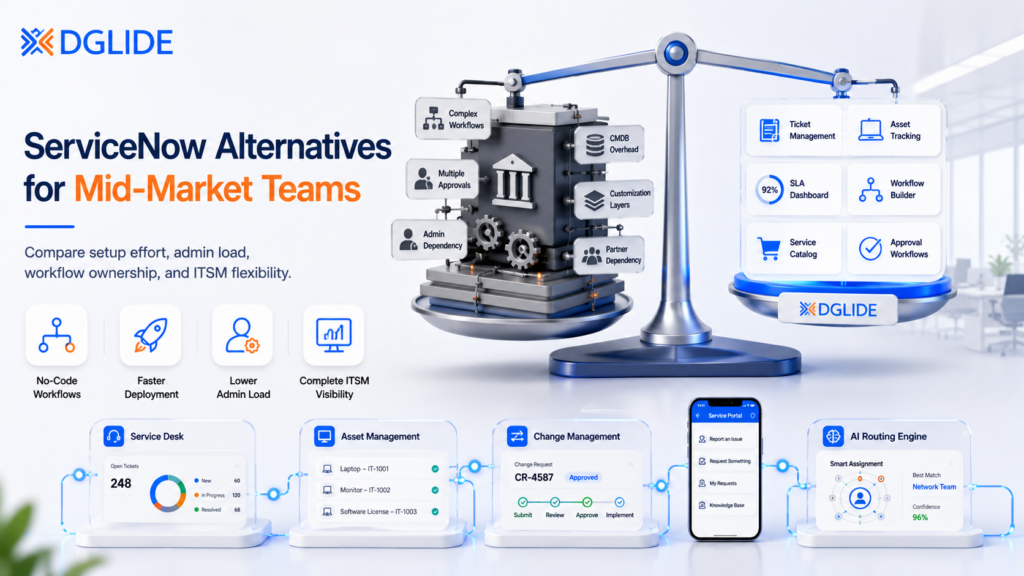
Most teams looking for a ServiceNow alternative are not questioning whether ServiceNow is powerful. They have seen the power. What they cannot absorb is the weight that comes with it. The months of implementation, the certified admins, the partner invoices, and a price that only appears after an NDA.
ServiceNow is built for the largest enterprises, and for them the depth is worth the cost. The strain shows up when a 300-person manufacturer, a regional facility-management firm, or a mid-market IT team buys enterprise weight they will never fully use. They wanted a service desk that fits their operation. They got a platform that needs a team to run it.
DGlide is a configurable operations platform for mid-market teams. Its servicedesk, ITSM, field service, and CRM modules sit on one no-code backbone, so an operations lead can change a workflow without filing a ticket with a certified admin. This guide compares the two honestly, including where ServiceNow is genuinely the better choice.
Short answer The best ServiceNow alternative depends on your size and need. True enterprises needing deep CMDB, ITOM, and global governance should compare BMC Helix or Ivanti. Customer-service teams should look at Zendesk or Salesforce. Mid-market operations, field, and IT-support teams that want fast, no-code deployment without enterprise weight are the right fit for a configurable operations platform like DGlide.
TL;DR
- ServiceNow is an enterprise platform. Its power is real, and so is its weight: 3 to 9 month implementations, certified admins, and partner fees that often run 3 to 5 times the license.
- ServiceNow does not publish pricing. Most teams pay a $10,000-plus annual minimum, then far more once modules, fulfiller licenses, and implementation are added.
- The Configuration Tax: with ServiceNow, the license is the cheap part. The real cost is that most changes go through a certified admin or a partner, so the system ossifies and a change backlog forms.
- DGlide is a mid-market configurable operations platform. Servicedesk, ITSM, field service, and CRM sit on one no-code backbone configured by the people who run the operation.
- Where ServiceNow wins: ITSM depth, ITOM and CMDB, mature AI, enterprise governance, scale, and a large partner and app marketplace.
- Where DGlide wins: deployment in weeks, no certified-admin dependency, native field service, and a far lower implementation burden.
- Honest fit: DGlide suits mid-market operations and service teams. It is not a replacement for ServiceNow at true enterprise scale.
Why Teams Start Looking for a ServiceNow Alternative
The first reason is the bill they cannot predict. ServiceNow publishes no pricing. Most teams start near a $10,000 annual minimum, then watch the number climb with per-fulfiller licenses, module add-ons, and required minimums that make a small deployment cost like a large one.
The second reason is time to value. A first-phase ServiceNow implementation typically runs three to nine months, and the implementation fees often run three to five times the annual license. A 300-person operation does not have a year and a partner budget to wait for a working service desk.
The third reason is ownership. ServiceNow rewards certified admins and partners, which means the team that runs the operation rarely controls the system that runs it. Every workflow change becomes a request, and requests become a queue.
📊 65% of customers expect companies to adapt to their changing needs When your service platform can only change through a certified admin or a partner, your operation cannot adapt as fast as your customers expect.
Source: Salesforce, State of the Connected Customer
A mid-market IT head does not abandon ServiceNow because it lacks features. They leave because they are paying for enterprise depth, and waiting on enterprise process, to run a mid-market operation. This is where affordable ITSM software built for their scale changes the math.
See how a servicedesk deploys in weeks, not quarters, and stays in your team’s hands at dglide.com.
The Configuration Tax
Here is the assumption worth challenging. Buyers compare ServiceNow on license price and feature lists. The real cost lives somewhere else. It is the price of every future change.
With ServiceNow, the license is the cheap part. Customization commonly consumes 50 to 60 percent of license cost, and most changes route through a certified admin or an implementation partner. So the system slowly ossifies. A field gets added next quarter. A workflow waits in a backlog. The platform that was sold as adaptable becomes the thing your team adapts around.
Run this five-minute diagnostic. List the last five process changes your team actually wanted in your service or operations tool. For each one, mark whether it shipped the same week by your own people, or waited on an admin, a partner, or a ticket. The waiting pile is your Configuration Tax, and it is the cost no license quote shows you.
⚠️ The hidden failure mode Enterprise platforms are sold on what they can do. The cost shows up in what it takes to change them. A capability you cannot reconfigure without a partner is a capability that ages into a constraint.
DGlide is built so the people who run the operation can change it. Workflows, forms, and field logic are configured without code, which is the practical meaning of fit over standardization. A configurable ITSM and ticketing workflow is reshaped by your operations lead, not queued behind a certified admin.
DGlide vs ServiceNow: The Complete Feature Comparison
The honest way to read this is by scale. ServiceNow is the deeper enterprise platform. DGlide is the lighter, faster, mid-market platform that an operations team can own. Feature data below draws on verified ServiceNow market data and DGlide’s current product. ServiceNow wins depth. DGlide wins ownership and speed.
Platform and fit
| Capability | ServiceNow | DGlide |
| Product category | Enterprise operations and ITSM platform | Mid-market configurable operations platform |
| Best-fit organization size | Large enterprise, thousands of users | SMB to mid-market |
| Who configures it | Certified admins and partners | Business users, no code |
| Module breadth | ITSM, ITOM, CSM, HR, SecOps, App Engine, and more | Servicedesk, ITSM, FSM, CRM on one backbone |
ITSM depth
| Feature | ServiceNow | DGlide |
| Incident, request, problem, change management | Yes (deep) | Yes (core) |
| CMDB and IT asset management | Yes (advanced) | Partial (asset management) |
| ITOM (discovery, event management) | Yes | No |
| Service catalog | Yes | Yes |
| SLA management | Yes | Yes |
| Knowledge base | Yes | Yes |
Field service and operations
| Capability | ServiceNow | DGlide |
| Work order creation and tracking | Yes | Yes |
| Technician assignment and scheduling | Yes | Yes |
| Preventive maintenance auto work orders | Yes | Yes |
| Route tracking | Yes | Yes |
| Distance-based expense calculation | Partial | Yes |
| OTP-based work order closure | Partial | Yes |
| Tool and asset management | Yes | Yes |
CRM and customer operations
| Feature | ServiceNow | DGlide |
| Lead and contact management | Partial | Yes |
| Pipeline with drag-and-drop Kanban | No | Yes |
| Omnichannel (email, WhatsApp, SMS) | Partial | Yes |
| Workflow automation and approvals | Yes | Yes |
AI and automation
| Feature | ServiceNow | DGlide |
| Mature AI assistant | Yes (Now Assist) | Partial (Glider Bot) |
| Predictive and AIOps | Yes | No |
| Workflow automation | Yes | Yes |
Configurability and ownership
| Feature | ServiceNow | DGlide |
| No-code change by business users | Limited (admin or developer led) | Yes |
| Change without a certified admin or partner | No | Yes |
| Custom app building | Yes (App Engine, pro and low code) | Yes (no-code configuration) |
Deployment and time to value
| Item | ServiceNow | DGlide |
| Typical first-phase implementation | 3 to 9 months | Weeks |
| Requires certified admins or partners | Yes | No |
| Self-sufficient configuration by the ops team | Limited | Yes |
Pricing and total cost
| Item | ServiceNow | DGlide |
| Public pricing | No | No |
| Pricing model | Quote-based, per fulfiller plus modules | Quote-based, no published model |
| Entry cost | ~ 100 to $200 per fulfiller per month 100 to $200 per fulfiller per month |
Not published |
| Implementation multiplier | 3 to 5 times the license | Low, no partner dependency |
| Best-fit budget | Enterprise | Mid-market |
Scale, governance, and ecosystem
| Item | ServiceNow | DGlide |
| Enterprise governance and multi-region | Yes (advanced) | Lighter |
| Partner and app marketplace | Yes (large) | Smaller |
| Analyst recognition in ITSM | Yes (category leader) | No |
Notes. ServiceNow pricing and implementation figures verified across 2026 industry sources; ServiceNow does not publish pricing. DGlide field-service and CRM rows reflect its current product; “Partial” on AI reflects the earlier-stage Glider Bot. DGlide also has no published pricing and is sold by custom quote.
1. ITSM depth
ServiceNow wins, clearly. Its incident, problem, and change management run deep, and its CMDB and ITOM give large IT organizations discovery, event correlation, and asset intelligence that mid-market tools do not attempt. If you run a global IT estate with thousands of configuration items, this depth is the reason ServiceNow exists.
DGlide covers the core that most mid-market teams use: incidents, requests, a service catalog, SLAs, and a knowledge base, with asset management rather than a full CMDB. Winner: ServiceNow.
2. Field service and operations
Near parity, with a leanness edge for DGlide. Both handle work orders, technician scheduling, preventive maintenance, and route tracking. DGlide adds distance-based expense calculation and OTP-verified closure as native, lighter capabilities.
The difference is not the checklist. It is that DGlide runs these on the same backbone as the servicedesk, so a ticket from a 60-technician manufacturer becomes a dispatched, verified job without a separate module purchase. Winner: Tie, with DGlide leaner and natively connected.
3. Configurability and ownership
This is DGlide’s strongest dimension. ServiceNow is highly configurable, but the configuring is done by certified admins or partners, which is why customization can consume 50 to 60 percent of license cost. The capability is real. The ownership sits outside your team.
DGlide is configured by the operations people who use it, without code. Workflows, forms, and field logic change the same week, not the next quarter. ServiceNow adapts through a specialist. DGlide adapts through you. Winner: DGlide.
4. AI and automation
ServiceNow wins on maturity. Now Assist and its predictive and AIOps capabilities are further along than DGlide’s earlier-stage Glider Bot, and for a large IT operation that AI depth is meaningful.
DGlide includes workflow automation and AI-assisted routing in the platform, but it is honest to say ServiceNow leads here. Winner: ServiceNow.
5. Deployment and time to value
DGlide wins, and it is not close for mid-market teams. A ServiceNow first phase runs three to nine months and leans on partners. DGlide deploys in weeks because the team starts on a working system configured to its workflows, not a blank enterprise platform that must be built out.
For a mid-market operation, the difference between weeks and quarters is the difference between solving this year’s problem and last year’s. Winner: DGlide.
6. Pricing and total cost
Both are quote-based, so neither offers transparent public pricing. The honest difference is total cost of ownership. ServiceNow carries a $10,000-plus minimum, per-fulfiller licensing, and an implementation that often costs three to five times the license.
DGlide carries no partner-led implementation multiplier and is sized for mid-market budgets, though you still have to ask for the number. Winner: DGlide on total cost and burden, with both opaque on list price.
7. Scale, governance, and ecosystem
ServiceNow wins. Its governance, multi-region controls, partner network, and app marketplace are built for the largest organizations, and its analyst recognition in ITSM is earned. DGlide is lighter on all of these by design. Winner: ServiceNow.
The scorecard
| Dimension | Edge | Why it matters for your team |
| ITSM depth | ServiceNow | CMDB, ITOM, deep change management |
| Field service and operations | Tie | DGlide leaner and natively connected |
| Configurability and ownership | DGlide | Your team changes it, no certified admin |
| AI and automation | ServiceNow | Now Assist and AIOps maturity |
| Deployment and time to value | DGlide | Weeks versus 3 to 9 months |
| Pricing and total cost | DGlide | No 3 to 5 times implementation multiplier |
| Scale, governance, ecosystem | ServiceNow | Enterprise scale and marketplace |
The pattern is honest. If you are a true enterprise that needs depth, governance, and AIOps, ServiceNow wins more dimensions and you should probably stay. If you are a mid-market operations, field, or IT team paying for enterprise weight you do not use, DGlide wins the dimensions that decide your year: ownership, deployment speed, and total cost.
Walk through a DGlide servicedesk configured around your operation, owned by your team, with DGlide at dglide.com.
Other ServiceNow Alternatives Worth Considering in 2026
No single tool wins for everyone. Entries are alphabetical, chosen for prominence in current search results and category fit, each with one honest limitation. Reviewed June 2026.
- BMC Helix ITSM is an enterprise-grade, AI-driven ITSM platform. Limitation: it carries enterprise weight and pricing similar to ServiceNow.
- DGlide is best for mid-market operations, field, and IT teams that want fast, no-code deployment they can own. Limitation: it is not built for 5,000-seat enterprises or deep CMDB and ITOM needs.
- Freshservice is a popular, AI-assisted ITSM tool with fast setup. Limitation: it is support and ITSM focused, lighter on field and operational workflows.
- Ivanti Neurons is strong on IT asset management, endpoints, and security. Limitation: it is enterprise focused and complex to operate.
- Jira Service Management suits software and dev-aligned teams. Limitation: it works best when you already run the Atlassian suite, and is less suited to field operations.
- ManageEngine ServiceDesk Plus is affordable and feature-rich. Limitation: the interface feels dated and advanced workflows need scripting.
- Zendesk is strong for multichannel customer service. Limitation: it is customer-support oriented, not internal ITSM or operations.
When DGlide Is the Right Fit, and When It Is Not
Honesty here saves a wasted procurement cycle. DGlide is the right ServiceNow alternative for a specific kind of team, and the wrong one for another.
DGlide fits when you are a mid-market operations, field-service, or IT team whose service and operational work spans tickets, technicians, assets, and approvals, and you want to deploy fast and own the configuration. It fits a machinery manufacturer running service and installations, a facility-management firm coordinating engineers, and an IT team tying field service and ticketing into one operations view. It fits teams running on operations management software rather than an enterprise suite.
DGlide is not the right pick at true enterprise scale. If you need a deep CMDB, ITOM and discovery, global multi-region governance, mature AIOps, and a large partner marketplace, ServiceNow’s depth is genuinely better, and you should buy it. There is no value in forcing a mid-market platform onto an enterprise problem.
📊 ServiceNow implementations typically run 3 to 9 months, with fees 3 to 5 times the license For a mid-market team, that is a year and a budget spent before the first workflow goes live. Time to value is the quietest line item, and the most expensive.
Source: ServiceNow implementation analysis, 2026
What Switching Actually Looks Like
Moving off, or away from, ServiceNow sounds heavy, which is why teams delay it. With a configurable platform sized for your operation, the switch is a configuration, not a multi-year program. DGlide follows a lifecycle that does not stop at launch.
- Deploy. Start on a working servicedesk and operations setup configured to your real processes, so you go live in weeks rather than quarters.
- Use. Your team runs daily work inside one system that maps to how the operation flows, across tickets, technicians, and approvals.
- Adapt. When a process changes, your own people reconfigure the workflow, with no certified admin and no partner invoice.
- Optimize. Real usage shows what to tighten, and the system is refined around it, so fit improves over time instead of ossifying.
This is the core idea behind the Living Service Model. Deployment is not the finish line. Fit is. Enterprise platforms ship after a long build and then resist change. Your operation moves on, and the system that justified its cost slowly becomes the reason you cannot move faster.
In 2026, two shifts make this urgent. ServiceNow pricing and AI add-ons keep climbing, and mid-market teams are consolidating tools to cut both cost and admin overhead. A platform your own team can run answers both at once. You can see related thinking in DGlide’s guide to service desk alternatives for field teams.
The Bottom Line
ServiceNow is a powerful platform, and at enterprise scale the depth justifies the weight. The question is not whether ServiceNow is good. It is whether you are large enough to need everything you are paying for.
If you run a global IT estate that needs CMDB, ITOM, and AIOps, keep ServiceNow. If you are a mid-market operations or service team paying enterprise prices, waiting enterprise timelines, and queueing behind certified admins to change a workflow, you do not need a smaller ServiceNow. You need a platform your own team can deploy and own. That is the line between an enterprise suite and a configurable operations platform.
Map your Configuration Tax with the DGlide team and see an operations platform your team can run at dglide.com.
Frequently Asked Questions
The best alternative depends on your size and need. Enterprises needing depth compare BMC Helix and Ivanti. Customer-service teams compare Zendesk and Salesforce. Mid-market operations, field, and IT teams that want fast, no-code deployment without enterprise weight are a strong fit for DGlide.
In enterprise ITSM, ServiceNow’s main competitors are BMC Helix and Ivanti. In customer service, Salesforce and Zendesk. In low-code operations, Microsoft Power Platform. For mid-market teams, lighter platforms like DGlide compete on deployment speed and total cost.
Yes. ServiceNow’s total cost is driven by minimum licenses, modules, and implementation fees that often run three to five times the license. Mid-market alternatives avoid the partner-led implementation and certified-admin dependency, which lowers total cost of ownership.
DGlide is a good ServiceNow alternative for mid-market operations, field-service, and IT-support teams that want fast, no-code deployment they can own. It is not built for large enterprises needing deep CMDB, ITOM, or global governance, where ServiceNow is the stronger choice.
