No-Code ITSM Platforms for Mid-Market Companies in India: What the Label Actually Means?
A mid-market IT Head in India shortlisting a no-code ITSM platform is usually not testing whether the tool has a drag-and-drop canvas. Every vendor's demo has one. The real test is whether someone in Facilities or HR can build a workflow themselves after go-live, not just click through the one IT already configured.
For a 200 to 800 person company running IT, facility requests, and branch operations on separate, half-configured tools, that decides whether the platform still needs a developer six months in, or never did.
The pattern usually looks like this:
A "no-code" builder that only IT can touch, so Facilities and HR still email requests
Drag-and-drop demos that work for the vendor's sample workflow, not your approval chain
A platform scoped to IT tickets alone, leaving branch ops on spreadsheets
This piece looks at what genuinely no-code means, and what to test before trusting the label. It also covers where DGlide's ITSM platform fits, alongside our cost breakdown of ITSM pricing in India.
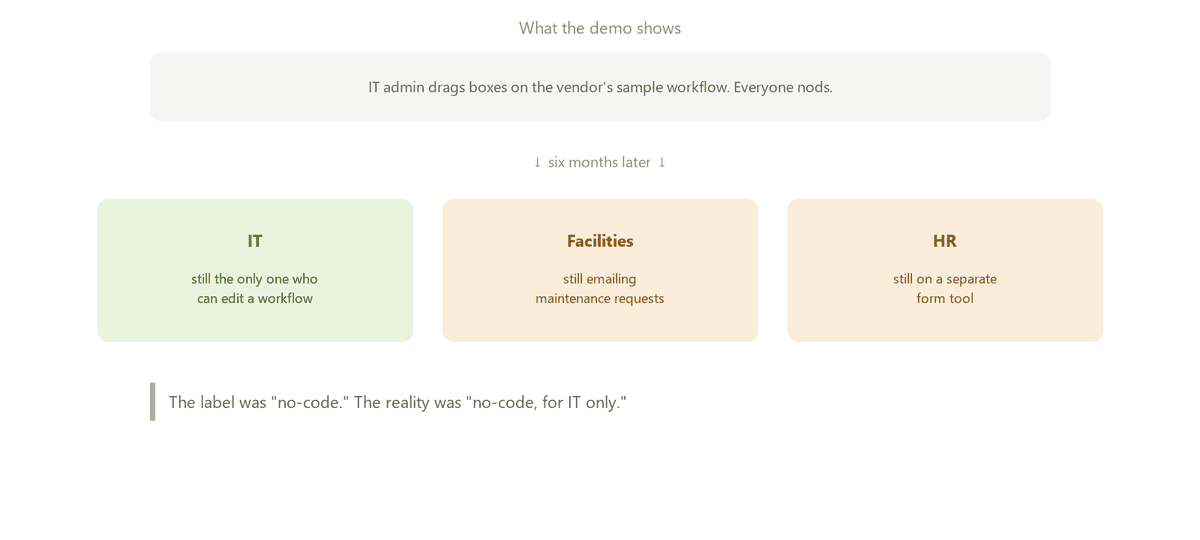
The label was no-code. The reality was no-code, for IT only.
TL;DR
Test whether a non-IT user can build a workflow after go-live, not just whether the demo has a drag-and-drop canvas.
Most "no-code ITSM" content scopes the label to IT tickets only, missing facilities, HR, and branch ops.
Citizen-developer adoption is now mainstream, so a platform locked to IT staff is already behind.
DGlide's mid-market fit centers on IT, facilities, and branch ops sharing one workflow builder.
A true no-code platform should not need a partner call to change a routing rule.
What Actually Makes an ITSM Platform "No-Code" for a Mid-Market Team?
A platform is genuinely no-code when a business user, not just IT, can build and change a workflow without a developer.
Who configures it matters more than the interface: A canvas that still routes back to IT for every change is no-code in name only.
Scope matters as much as the builder: No-code that only touches IT tickets leaves facility requests on email.
Change speed is the real test: A genuine no-code platform lets a service manager edit a routing rule in minutes.
None of this makes vendors using "no-code" loosely dishonest. It just means the label needs a second look before it goes on a shortlist.
Still routing every workflow change through IT because your "no-code" tool only lets IT touch it? See a business user build a workflow live in 15 minutes.
Where Most "No-Code ITSM" Claims Fall Apart After Go-Live
Most no-code ITSM claims fall apart the moment someone outside IT tries the builder. The demo shows an admin dragging boxes. Six months later, that admin is the only person who can touch it.
The problem: most vendors built their no-code layer for IT's own tickets, then bolted a generic form tool on for everyone else.
The solution: IT, facilities, and branch operations sharing the same no-code engine, not a separate form tool stapled on.
In deployments we have run for Indian mid-market teams, tools that called themselves no-code still needed a partner call to change an approval step outside the original IT workflow.
If Facilities is still emailing maintenance requests because "no-code" never got extended past IT, that gap is worth closing. Talk to us for 15 minutes.
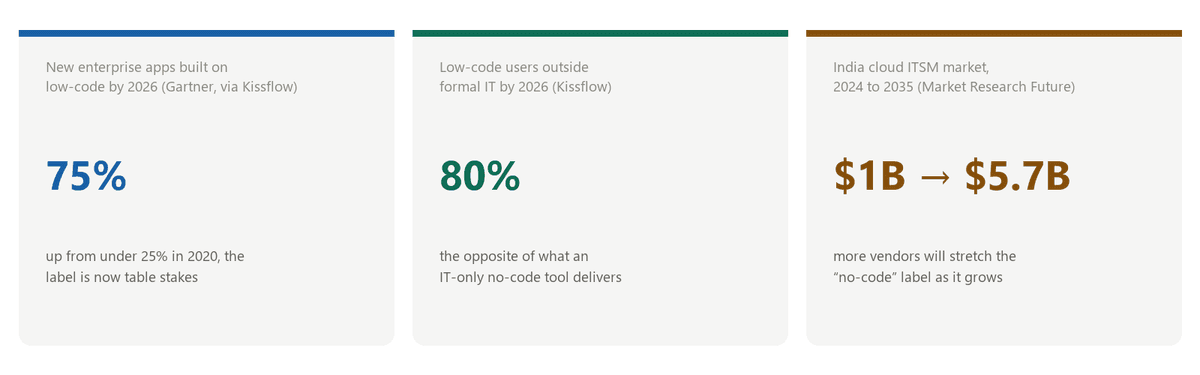
The data behind the no-code label
What Should You Test Before Trusting a "No-Code" Label?
Test who can build a workflow, how fast a change goes live, and whether the scope extends past IT. A study by Market Research Future found India's cloud ITSM market is projected to grow from $997.5 million in 2024 to $5.7 billion by 2035, so more vendors will stretch the label as the market grows.
Ask a non-IT stakeholder to build a test workflow live. If they cannot without a support call, it is not truly no-code for your team.
Check whether the builder covers Facilities and HR, not just IT incidents and requests.
One honest note: if your priority is enterprise-scale ITOM and CMDB depth across thousands of seats, a platform like ServiceNow is the more honest fit.
If your last "no-code" change still needed a support ticket, test that before you renew. Ask us to show a live workflow build.
No-Code ITSM Platforms Compared for Indian Mid-Market Teams
The right platform depends on how far past IT the builder reaches. Freshservice and ManageEngine lead for IT-only service desks. For IT, facilities, and branch ops on one platform, DGlide fits.
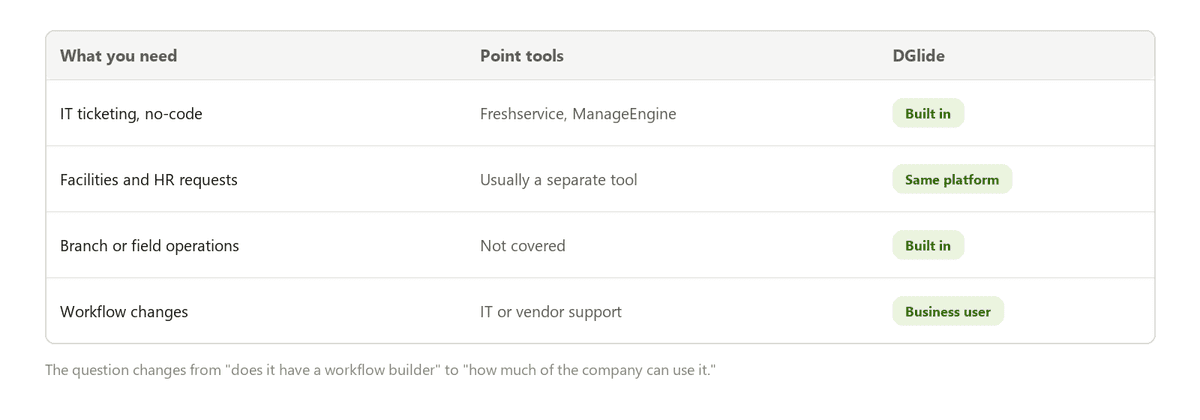
Which platform reaches how far past IT
Read that way, the question changes from "does it have a workflow builder" to "how much of the company can actually use it."
Why Should You Choose DGlide?
If you are evaluating a no-code ITSM platform because IT keeps fielding requests that should have gone to Facilities or HR, DGlide extends the same no-code builder across all three.
IT, facilities, and branch ops workflows sit in one no-code engine, not a ticketing core with a bolted-on form tool.
A service manager, not a developer, builds and edits approval chains directly.
DGlide deploys in days to weeks, at roughly 40 percent lower cost than legacy ITSM vendors. Pricing does not scale with every add-on.
vs Freshservice: DGlide's no-code builder extends to facilities and branch ops; Freshservice stays scoped to IT tickets.
vs ManageEngine: DGlide changes workflows by drag-and-drop; ManageEngine needs scripting past basic routing.
DGlide fits mid-market teams where IT, facilities, and branch ops overlap, not enterprise ITOM programs. Book a free 15-minute demo to see a workflow built live.
Conclusion
A no-code ITSM platform for a mid-market Indian company is not the one with the flashiest demo. It is the one a business user outside IT can build on, months after the sales call ends.
For an IT Head who acts on this, the test is simple: hand the builder to someone in Facilities before you sign. If they build a working form without calling support, the label is real.
FAQs
What makes an ITSM platform genuinely no-code for mid-market companies in India?
A genuinely no-code platform lets a business user build workflows without a developer. It should cover more than IT tickets alone. Facilities, HR, and branch ops should share the builder.
Is DGlide a good no-code ITSM platform for Indian mid-market teams?
Yes, DGlide fits mid-market Indian teams needing IT, facilities, and branch ops in one platform. A service manager makes workflow changes, not a developer. Deployment typically takes days to weeks.
Does DGlide replace ServiceNow for large enterprise ITSM needs?
No, DGlide is scoped for mid-market teams, not enterprise ITOM programs. ServiceNow fits organizations needing deep CMDB depth. DGlide fits IT, facilities, and branch ops overlap instead.
How is DGlide different from Freshservice or ManageEngine for no-code workflows?
DGlide extends no-code building past IT to facilities and branch operations. Freshservice and ManageEngine keep tools scoped mainly to IT. ManageEngine also needs scripting for advanced routing.