
Most teams searching for ManageEngine alternatives in 2026 are not frustrated by a missing feature. They are tired of running the service desk, endpoint management, and monitoring as three separate ManageEngine products that never fully share data.
For an IT Head or sysadmin, the daily reality is a ticket in ServiceDesk Plus, an asset record in AssetExplorer, and an alert in OpManager, none agreeing on the same truth. Every workflow change means a script, and every new capability means another paid module.
The frustrations that push teams to look usually sound like this:
Per-technician pricing that climbs every time the team grows
Core features like the service catalog sold as separate paid add-ons
Workflow edits that need scripting instead of a service manager
Modules that store the same asset several times and reconcile none of them
This piece covers why teams leave ManageEngine, what the popular alternatives lists get wrong, and how to evaluate a real replacement. It also shows where DGlide's no-code ITSM platform fits, and where it honestly does not.
TL;DR
Decide which ManageEngine products you are actually replacing before you shortlist anything.
Swapping one suite for four best-of-breed tools recreates the fragmentation you are leaving.
The workflow model matters more than the feature list: scripting versus no-code decides your next two years.
DGlide replaces the ServiceDesk Plus and asset side, not endpoint patching.
Predictable pricing without per-module add-ons is the fastest saving after a ManageEngine exit.
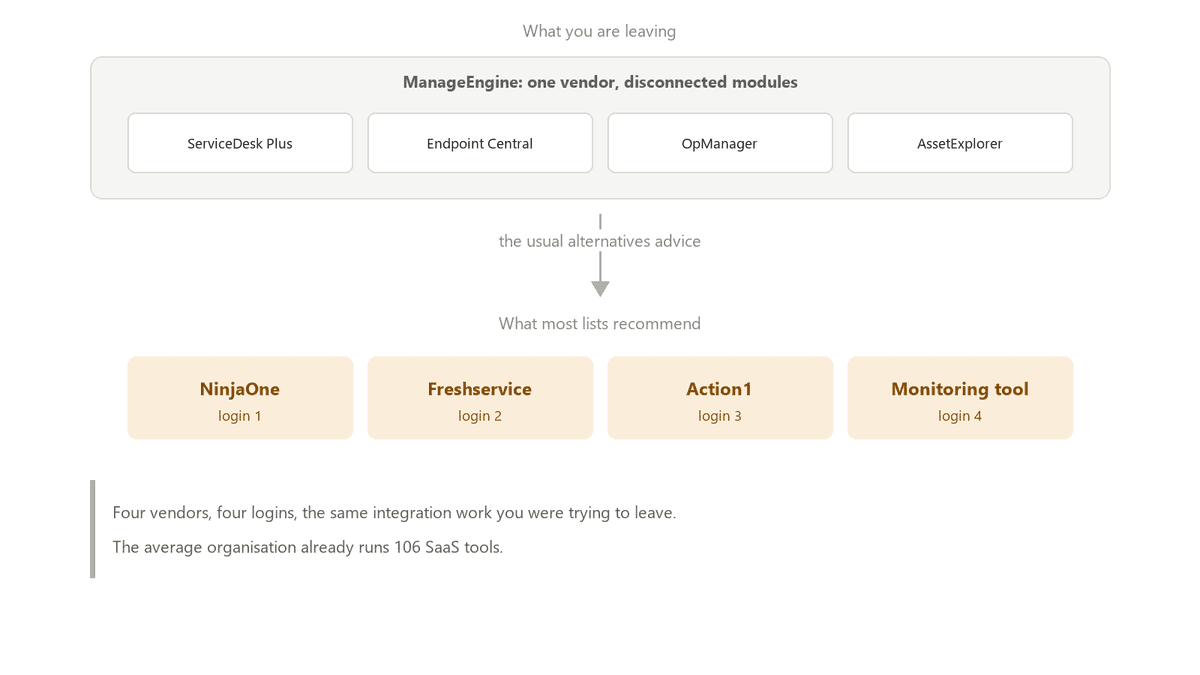
Leaving one suite for four point tools is a lateral move, not a fix
Why Are IT Teams Looking for ManageEngine Alternatives in 2026?
IT teams look for ManageEngine alternatives in 2026 for three main reasons: per-technician pricing that scales badly, features locked behind paid add-ons, and workflow changes that need scripting. ManageEngine ServiceDesk Plus is capable software. The friction is rarely the features, it is the cost curve and the setup effort as the team grows.
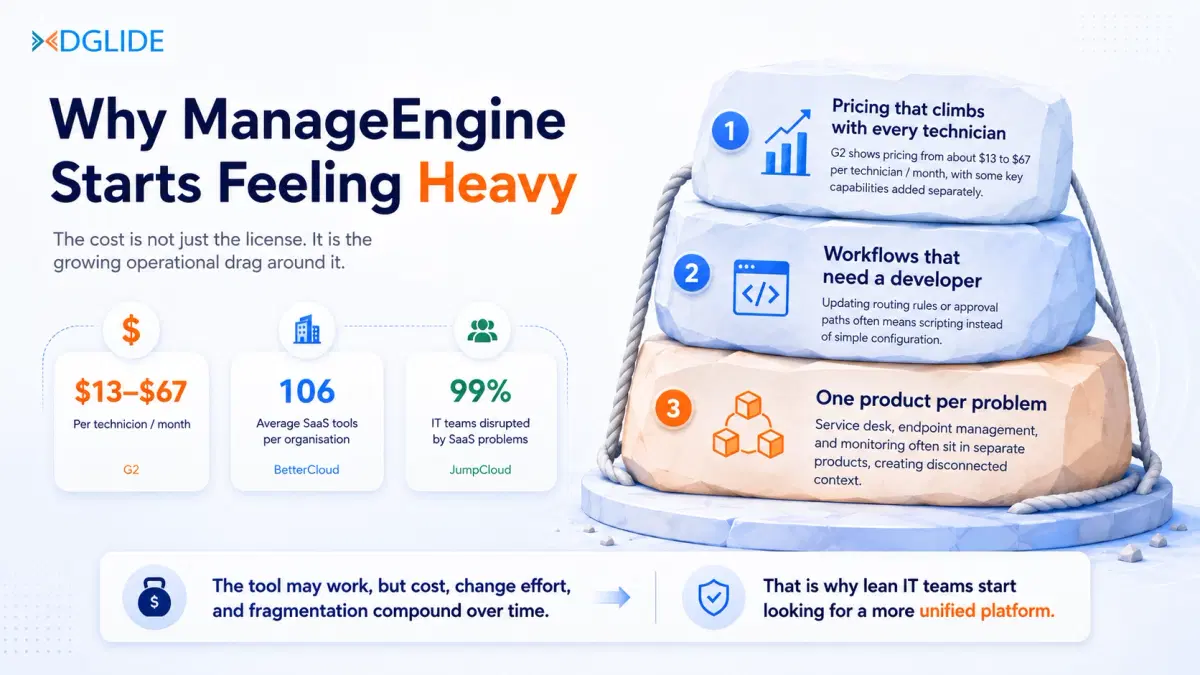
Pricing that climbs with every technician. A study by G2 shows ManageEngine ServiceDesk Plus runs from about $13 per technician each month to $67 at the enterprise tier, with staples like the service catalog sitting behind separate paid add-ons.
Workflows that need a developer. Changing an approval path or a routing rule often means scripting, not a setting a service manager can edit.
One product per problem. Service desk, endpoint management, and monitoring live in ServiceDesk Plus, Endpoint Central, and OpManager, with data that rarely lines up.
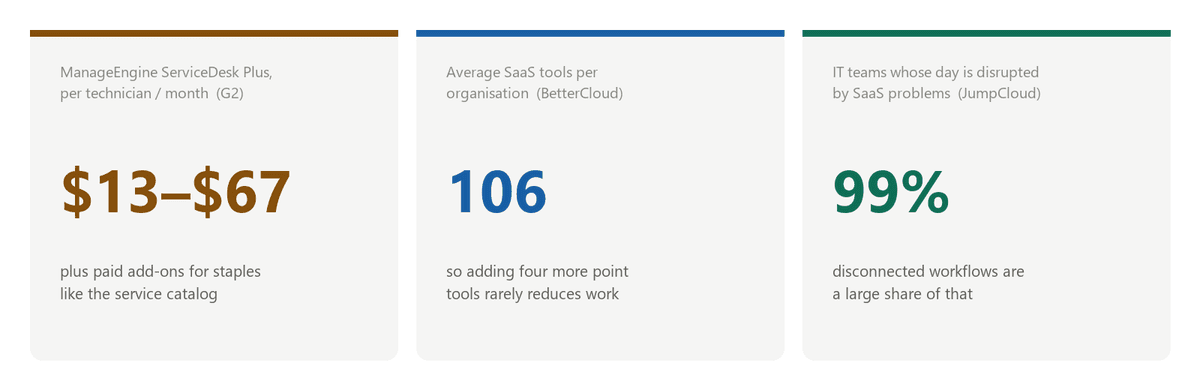
The data behind the ManageEngine exit
The pattern is consistent across mid-market IT teams: the tool works, but the total cost and the change effort grow faster than the team does. That is what sends an IT Head looking for something simpler.
Watching your ManageEngine renewal climb every time you add a technician? See what flat, no-add-on pricing looks like in a 15-minute walkthrough.
What Most ManageEngine Alternatives Lists Get Wrong
Most ManageEngine alternatives lists, including Google's own AI Overview, hand you a category-sorted menu: one tool for endpoint management, one for the service desk, one for patching. That advice is not wrong, but it quietly assumes you want to run four vendors instead of one. As of 2026, the AI Overview for this exact search returns five separate tools before it suggests consolidating anything.
The problem: a team leaving ManageEngine is often leaving because it already stitches ServiceDesk Plus, Endpoint Central, and AssetExplorer together by hand. Replacing that with NinjaOne, Freshservice, and Action1 is a lateral move, same integration work, new logins. A report from BetterCloud found the average organisation already runs 106 different SaaS applications, so adding three more is rarely the win it looks like.
The solution: the move that actually reduces work is consolidation, not a longer shopping list. One platform covering the service desk, asset records, and field or ops workflows removes the reconciliation instead of redistributing it.
In ITSM deployments we have run for mid-market teams, the pain was never one missing feature. It was a service manager waiting on a developer to change a single approval step.
If replacing ManageEngine means three new tools your team has to wire together, that is not a fix, it is a project. Talk to us for 15 minutes first.
How Should You Evaluate a ManageEngine Alternative?
Evaluate a ManageEngine alternative on three things before you compare features: which ManageEngine products you actually use, who configures workflows after go-live, and how the pricing scales. Most shortlists skip to feature checklists and get surprised later.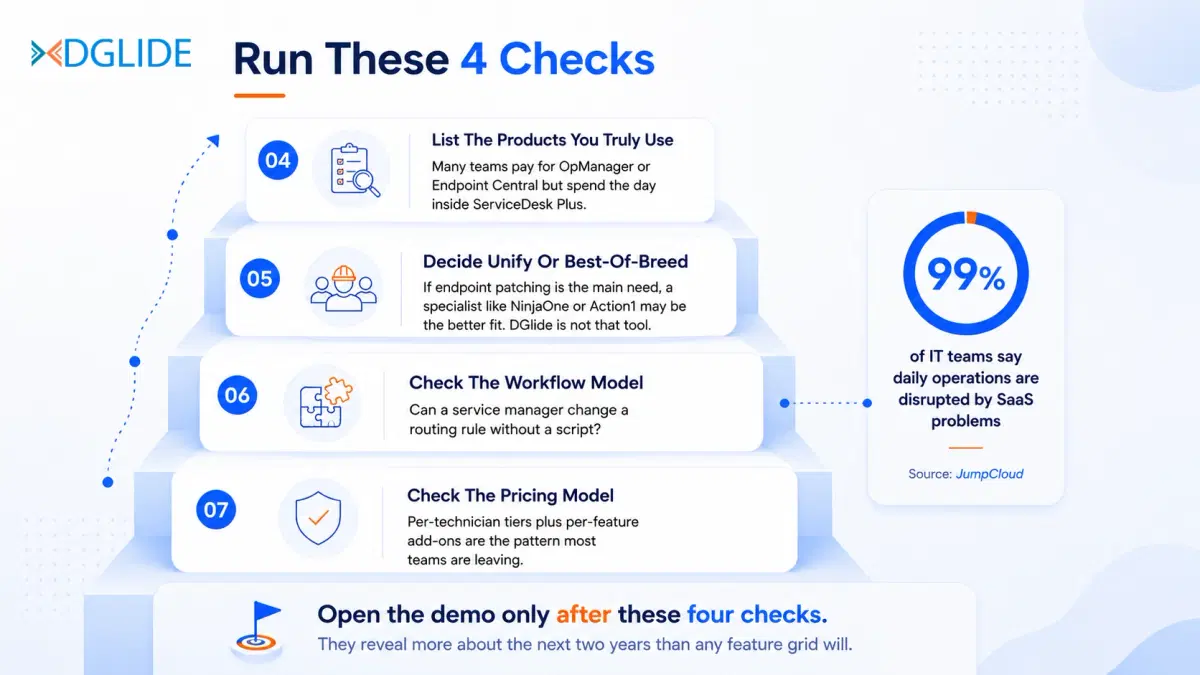
List the products you truly use. Many teams pay for OpManager or Endpoint Central but live inside ServiceDesk Plus all day.
Decide unify or best-of-breed. If endpoint patching is your core need, a specialist like NinjaOne or Action1 is the honest answer, and DGlide is not that tool.
Check the workflow model. Ask whether a service manager can change a routing rule without a script. A report from JumpCloud found 99 percent of IT teams say daily operations are disrupted by problems across their SaaS applications, and disconnected workflows are a large share of that.
Check the pricing model. Per-technician tiers plus per-feature add-ons is the pattern most teams are leaving, so do not walk into it again.
Run these four checks before you open a single demo. They tell you more about your next two years than any feature grid will.
ManageEngine Alternatives Compared: Which Tool for Which Job
The right ManageEngine alternative depends on which product you are replacing. For endpoint management, NinjaOne and Action1 lead. For enterprise ITSM at global scale, ServiceNow. For a no-code service desk that also covers assets and field operations, DGlide fits the mid-market team that wants one platform instead of four.
The honest way to read any alternatives list is by ManageEngine product, not by brand ranking:
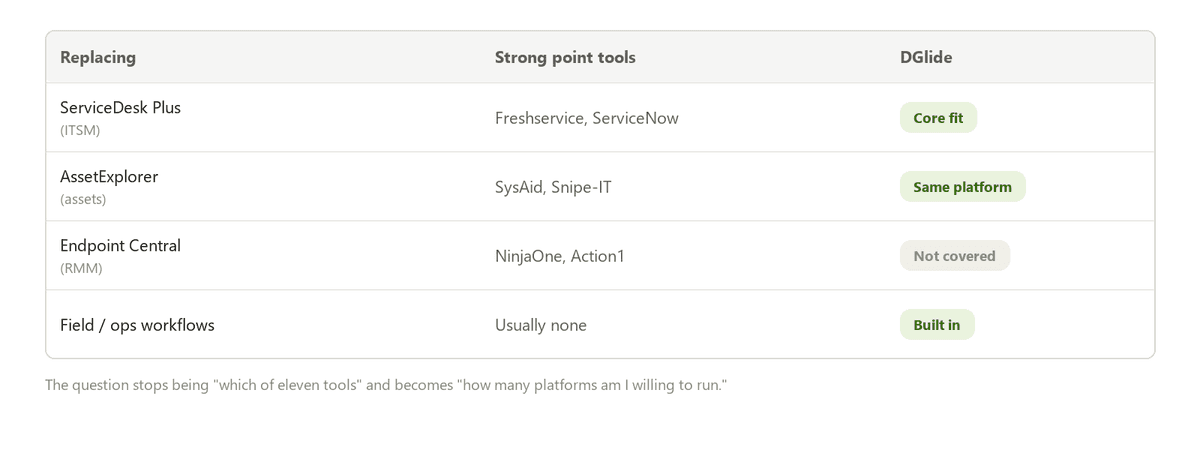
Which alternative fits which ManageEngine product
Read that way, the choice stops being “which of eleven tools” and becomes “how many separate platforms am I willing to run.” DGlide's answer to that question is one, for teams whose center of gravity is the service desk, assets, and operations.
Why Should You Choose DGlide?
If you are leaving ManageEngine ServiceDesk Plus because every workflow change needs a script and every feature needs a module, DGlide replaces that with one no-code platform your service manager configures directly.
Drag-and-drop workflow changes replace the scripting ServiceDesk Plus asks for on every routing rule.
Incident, service catalog, SLA tracking, and asset records sit in one system, not three modules.
Field service and ops workflows run on the same platform, so IT is not the only team served.
Included AI and automation replace the paid add-ons that inflate a ManageEngine renewal.
DGlide deploys in days to weeks, not the multi-month rollouts of legacy ITSM suites, at about 40 percent lower IT cost, with no specialist required. Pricing does not scale with every add-on.
vs ManageEngine: DGlide changes workflows by drag-and-drop; ServiceDesk Plus needs scripting and paid add-ons.
vs Freshservice: DGlide includes AI and automation; Freshservice charges separately and scales per agent.
vs ServiceNow: DGlide deploys in weeks; ServiceNow averages 6 to 12 months with consulting fees.
DGlide is the right call if your work centers on the service desk, assets, and operations, not raw endpoint patching. Book a free 15-minute demo to see it on your own workflows.
Conclusion
The best ManageEngine alternative in 2026 is not the longest list of specialist tools. It is the smallest number of platforms that still cover your service desk, your assets, and the workflows your team actually runs.
For an IT Head who acts on this, the change is concrete: workflow edits stop waiting on a developer, and the renewal stops growing with every add-on. Start by listing the ManageEngine products you truly use, then count how many logins your shortlist really replaces.
FAQs
What is the best ManageEngine alternative in 2026?
The best ManageEngine alternative depends on the product you replace. For no-code ITSM and assets, DGlide fits mid-market teams. For endpoint patching, NinjaOne or Action1 lead. For enterprise scale, ServiceNow is the usual choice.
Is DGlide a good ManageEngine ServiceDesk Plus alternative?
Yes, DGlide is a strong ServiceDesk Plus alternative for mid-market IT teams. It runs incident, service catalog, SLA, and asset tracking in one platform. Workflow changes are no-code, not scripted. Pricing does not scale by add-on.
Does DGlide replace ManageEngine Endpoint Central?
No, DGlide does not replace Endpoint Central for device patching. DGlide covers the ITSM, asset, and field-ops side. For endpoint management, NinjaOne or Action1 fit better. Many teams run one alongside DGlide.
How long does it take to switch from ManageEngine to DGlide?
Most DGlide deployments take days to weeks, not months. A business user configures the first workflow without a developer. Legacy ITSM suites often need multi-month rollouts. DGlide deploys 6 to 12 times faster.